





What You Need to Know About Inpatient Rehab Accepting Insurance
Finding inpatient rehab accepting insurance is more achievable than most people realize — and understanding how it works can be the difference between getting help now and waiting too long. For many individuals and families in New Jersey, the financial barrier is the single most daunting obstacle to recovery. The fear of a mountain of debt often keeps people trapped in the cycle of addiction, even when they are ready to change. However, the landscape of healthcare has shifted significantly in the last decade, making high-quality, evidence-based care more accessible than ever before.
Quick answer: Does insurance cover inpatient rehab?
- Yes. The Affordable Care Act requires most major health plans to cover medically necessary substance use disorder treatment.
- Medicaid (NJ FamilyCare) covers detox, residential, and outpatient rehab for eligible New Jersey residents.
- Medicare covers inpatient services when admitted to a qualifying clinical facility.
- Private commercial plans (Aetna, Cigna, UnitedHealthcare, BlueCross, etc.) typically cover residential rehab when treatment is deemed medically necessary.
- Your costs depend on your deductible, copay, and whether your rehab is in-network or out-of-network.
Here’s a reality check: in 2024, roughly 10.2 million Americans needed substance use treatment — but only about 1 in 5 actually received it. Cost and confusion about insurance are two of the biggest reasons people don’t get help. At Woodmont Treatment Center, we believe that financial literacy is a component of the healing process. When you understand your benefits, you can focus entirely on your clinical progress rather than worrying about the bill.
If you are a resident of Sussex or Warren County, Woodmont Treatment Center is your local partner in recovery. Contact us today to verify your insurance and begin your journey in a setting designed for peace, not clinical isolation.
If you’re a New Jersey resident dealing with opioid dependence, alcohol addiction, or a co-occurring mental health condition, this guide breaks down everything the rehab industry doesn’t always make obvious — from how your benefits actually work, to how facilities like Woodmont Treatment Center in Sussex and Warren County help you navigate every step. We provide a sanctuary for healing that feels like a home, ensuring that your environment supports your recovery journey from the moment you arrive.
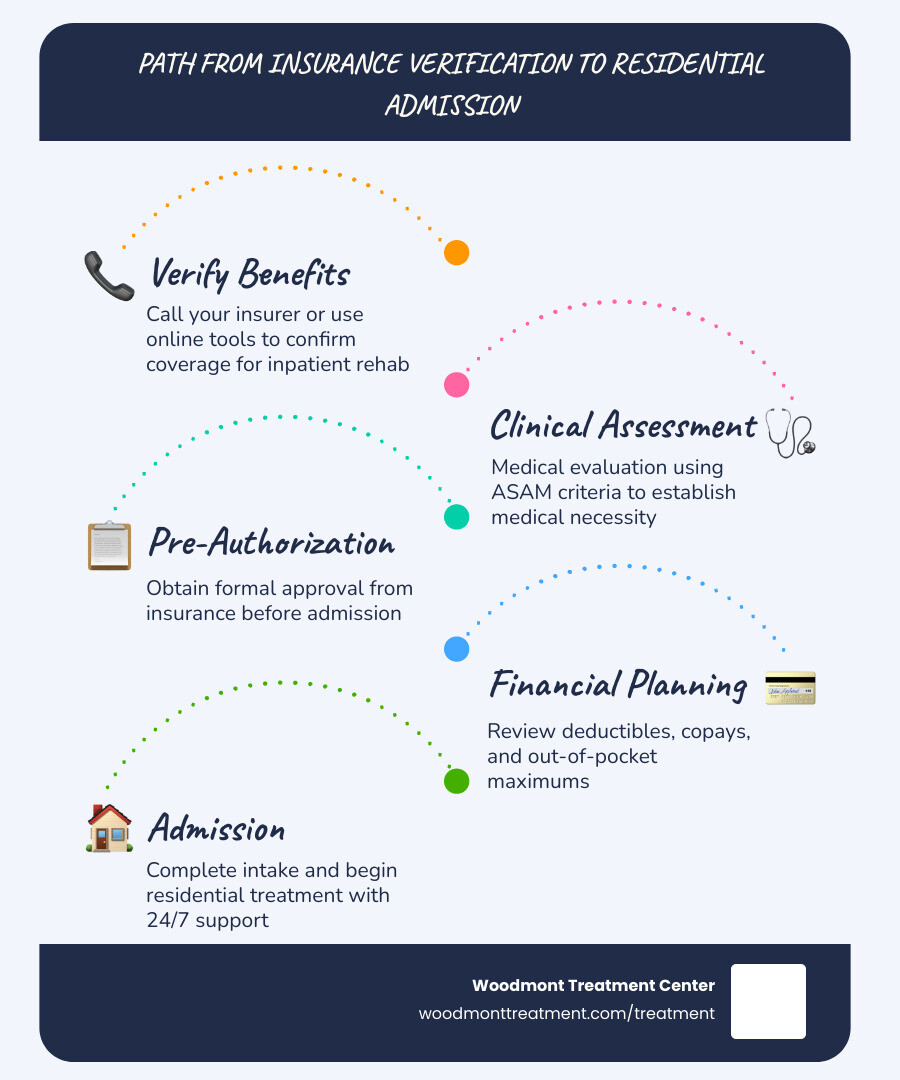
Key inpatient rehab accepting insurance vocabulary:
1. The Affordable Care Act Transformed Addiction Coverage
It wasn’t that long ago that insurance companies could treat addiction as a “pre-existing condition” or simply refuse to cover it altogether. The landscape changed dramatically with the passage of the Affordable Care Act (ACA). For those of us seeking inpatient rehab accepting insurance, the ACA was a game-changer because it designated mental health and substance use disorder (SUD) services as “essential health benefits.”
This means that if you have a major health insurance plan, they are legally required to offer some level of coverage for addiction treatment. Furthermore, the Mental Health Parity and Addiction Equity Act ensures that most plans must offer behavioral health benefits that are comparable to their medical and surgical benefits. You wouldn’t be denied coverage for a broken leg; the law says you shouldn’t be denied coverage for a life-threatening addiction either. This federal mandate was designed to eliminate the stigma that once allowed insurers to provide substandard coverage for brain-based illnesses. For a broad overview of these protections, the Affordable Care Act and Mental Health Parity Act offer helpful background on why addiction treatment coverage is now treated as a core part of modern healthcare.

At Woodmont Treatment Center, we see the benefits of these protections every day. We help families navigate The Ultimate Guide to Rehab Covered by Insurance NJ to ensure they are getting the full extent of the benefits they’ve paid for through their premiums. Our clinical team works tirelessly to document the progress of our residents, ensuring that insurance companies see the tangible value and necessity of the care being provided.
Understanding Federal Mandates for Addiction Treatment
The 2024 statistics are a stark reminder of why these mandates matter: while over 10 million people needed help, only 19.3 percent received it. Federal mandates aim to close this gap by ensuring that private insurance plans treat addiction with the same weight as physical ailments. This includes everything from the number of days allowed in a facility to the copay amounts for therapy sessions.
Parity protections mean that insurance companies cannot impose more restrictive “quantitative” limits (like a cap on the number of days) or “non-quantitative” limits (like tougher criteria for medical necessity) on addiction treatment than they do for other medical care. This ensures that if your plan offers unlimited doctor visits for chronic conditions like diabetes, they must offer similar flexibility for chronic conditions like substance use disorder.
Why “Medically Necessary” is the Key to Coverage
While the law requires coverage, the “golden ticket” to accessing it is the term “medically necessary.” Insurance companies don’t just pay for a 30-day stay because you ask for it; they pay because a clinical assessment proves that you need that specific level of care to survive and recover. This assessment is conducted by licensed professionals who evaluate the severity of the addiction, the risk of withdrawal, and any co-occurring mental health issues.
We utilize the ASAM (American Society of Addiction Medicine) criteria to determine the appropriate level of care. This data-driven approach is essential for securing insurance authorization. By showing that a patient meets specific markers for withdrawal risk, co-occurring conditions, or relapse potential, we can advocate for the coverage they deserve. You can learn more about How Data-Driven Treatment Plans Improve Patient Outcomes to see how we bridge the gap between clinical need and insurance approval. Our goal is to provide a level of clinical rigor that leaves no doubt about the necessity of our residential programs.
2. Private Insurance Can Unlock Luxury, Non-Clinical Settings
There is a common misconception that if you use insurance, you have to go to a cold, sterile, state-funded facility. While state-funded programs provide a vital service, they are often plagued by long waitlists and are forced to prioritize only the highest-risk groups, such as pregnant women or individuals with IV drug use history. These environments, while well-intentioned, often feel institutional and can inadvertently increase the stress levels of those seeking help.
If you have private commercial insurance, you often have the flexibility to choose a premier, estate-style facility. Private insurance allows you to move away from the “institutional” feel and toward a setting that feels like a home. This is a major advantage because the environment in which you heal significantly impacts your stress levels and your ability to focus on the work of recovery. At Woodmont, we have intentionally designed our Sussex County facility to be a sanctuary of peace, featuring comfortable furnishings, natural light, and a layout that encourages community and reflection.

When researching your options, it’s helpful to look at The 10 Best Affordable Rehabs in New Jersey Compared to see how private insurance can make high-end care accessible. For those in Sussex and Warren County, Woodmont offers the high-end, non-clinical environment you need to focus on lasting recovery.
The Reality of Medicaid vs. Private Commercial Plans
In New Jersey, Medicaid (NJ FamilyCare) is a lifeline for many. It covers detox, residential treatment, and aftercare. However, not every facility accepts Medicaid. Some of the most premier residential programs are exclusively in-network with private commercial plans. This is often due to the higher staffing ratios and specialized clinical modalities offered at private centers.
Commercial plans often offer a wider “network” of providers, giving you more freedom to choose a facility based on its clinical reputation and amenities rather than just its funding source. If you are curious about the different paths available, you can find more info about residential treatment on our services page. We work with a wide range of commercial providers to ensure that our high standard of care is available to as many people as possible.
Avoiding the “Institutional Feel” in Sussex County
We believe that recovery shouldn’t feel like a punishment. In Sussex County and Warren County, we are proud to offer a holistic care environment that feels like a retreat rather than a ward. Our estate setting allows for personalized therapy in rooms that look like living rooms, not exam rooms. This distinction is vital; when a patient feels like a “person” rather than a “patient number,” their engagement in therapy increases exponentially.
Choosing a facility that avoids a sterile atmosphere helps reduce the “fight or flight” response many people feel when entering treatment. When you feel safe and comfortable, your brain is more receptive to the evidence-based therapies we provide. For a better idea of what this looks like, check out our guide on What to Expect at an Inpatient Addiction Rehab Center. Our Andover Township location is specifically designed to foster this sense of safety and tranquility.
3. Your Out-of-Pocket Maximum is a Safety Net, Not Just a Cost
When people look at their insurance summary, they often get sticker shock from the “deductible.” However, the most important number for someone seeking inpatient rehab accepting insurance is actually the Out-of-Pocket Maximum. This is the absolute limit on what you will have to pay for covered services in a single calendar year.
Once you hit this limit, your insurance provider typically covers 100% of covered services for the rest of the calendar year. Because inpatient rehab involves 24/7 care, many patients meet their deductible and hit their out-of-pocket maximum during their stay. This means that while the initial cost might seem high, the insurance company ends up picking up the vast majority of the bill for the remainder of your treatment and subsequent aftercare, including outpatient services and medication management.
| Feature | In-Network | Out-of-Network |
|---|---|---|
| Negotiated Rates | Yes (Lower costs) | No (Higher costs) |
| Deductible | Lower | Higher |
| Copay/Coinsurance | 10% – 30% typically | 40% – 50% or more |
| Out-of-Pocket Max | Protected by plan limits | May not have a cap |
| Pre-authorization | Handled by facility | Often patient’s responsibility |
| Balance Billing | Prohibited | Common |
Understanding these nuances is part of An Essential Guide to Evidence-Based Inpatient Rehab. It is also important to note that many plans have separate deductibles for in-network and out-of-network care, which is why staying in-network is almost always the most financially sound decision.
How Financial Case Managers Maximize Your Benefits
You shouldn’t have to be an insurance expert to get sober. At Woodmont Treatment Center, our financial case managers handle the “heavy lifting.” We perform the initial benefit verification, but we don’t stop there. We provide constant clinical updates to your insurance company to justify continued stay (concurrent reviews) and handle the appeal process if a claim is initially denied. Our team acts as your advocate, ensuring that the insurance company honors the terms of your policy.
We also offer interest-free payment plans for those who need help covering their deductible. Our commitment to financial transparency means you’ll know exactly what to expect before you walk through our doors. We believe that financial stress should never be a reason to leave treatment early, and we work with families to find creative solutions that keep the focus on healing.
4. Insurance Covers the Full Continuum of Care, Not Just Detox
A common mistake is thinking that insurance only covers the “emergency” part of rehab — the detox. In reality, modern insurance plans are designed to cover the full continuum of care. This is vital because detox only cleans the body; residential treatment and aftercare are what heal the mind and change behavior. A short-term detox without follow-up care is often just a “revolving door” that leads back to use.
The continuum of care usually looks like this:
- Medical Detox: Managing physical withdrawal in a safe, supervised setting.
- Residential Inpatient: 24/7 structured environment with intensive therapy and community support.
- Partial Hospitalization (PHP): High-level care during the day, returning home or to sober living at night.
- Intensive Outpatient (IOP): Transitioning back to daily life with several hours of therapy per week.
You can find more info about inpatient services and how they fit into this journey on our website. Each step is designed to gradually increase your autonomy while maintaining a safety net of clinical support.
Medical Detoxification: The First Step
Insurance companies almost always cover medical detox because it is considered a life-saving intervention. Withdrawal from substances like alcohol or benzodiazepines can be fatal without 24/7 medical monitoring. We provide a safe, supervised environment to manage these risks, using medications to ease discomfort and prevent complications. For more details, explore more info about detoxification services. Our detox program is the foundation upon which the rest of your recovery is built.
Residential Treatment: Long-Term Success
Once detox is complete, residential treatment begins. Most insurance plans cover stays ranging from 28 to 90 days, depending on progress and clinical necessity. During this time, we use evidence-based therapies like Cognitive Behavioral Therapy (CBT) and Dialectical Behavior Therapy (DBT). We also specialize in trauma-informed care, which is essential for patients with a dual diagnosis. By addressing the underlying trauma that often fuels addiction, we help our residents achieve lasting change. Learn more about the more info about addiction conditions we treat to see how our programs are structured to address the whole person, not just the symptoms of use.
5. “In-Network” Status Can Significantly Lower Your Barrier to Entry
Choosing an “in-network” facility is the most effective way to lower your costs. When a facility is in-network, they have a pre-negotiated contract with your insurance company. This means the insurance company pays a set rate, and you are protected from “balance billing” (being charged the difference between what the insurance paid and what the facility normally charges). This protection can save families tens of thousands of dollars over the course of a treatment stay.
Woodmont Treatment Center is proud to be in-network with many major providers. Our Joint Commission accreditation and CARF certification are signals to insurance companies that we provide the highest standard of clinical excellence, which helps us maintain these partnerships and keep care accessible for Sussex and Warren County residents. If you are looking for an in-network provider in Sussex or Warren County, contact Woodmont today to maximize your benefits.
Questions to Ask Your Insurance Provider Today
Before you commit to a program, call the behavioral health number on the back of your card and ask:
- Is this facility in-network for my specific plan?
- How many days of residential treatment are covered per year?
- Do I have a separate deductible for mental health services?
- Does my plan cover telehealth for aftercare?
- What is my current out-of-pocket maximum balance?
- Are there any specific exclusions for substance use treatment?
If this feels overwhelming, we can do it for you. Our admissions team is expert at navigating these calls and can often get a clearer picture of your benefits in a fraction of the time. You can find more info about intensive outpatient services to see how we continue to support you after the residential phase, ensuring that your insurance benefits are utilized effectively throughout your entire recovery journey.
6. Hidden Costs are Avoidable with Proper Advocacy
Even with inpatient rehab accepting insurance, “billing shock” can happen if a facility isn’t transparent. Some centers might accept your insurance for the “room and board” but then send you separate, massive bills for lab work, doctor visits, or medications. This practice is unfortunately common in the industry and can lead to significant financial stress during a time when you should be focused on healing.
At Woodmont, we believe in radical transparency. We provide itemized estimates that break down:
- Facility Fees: The cost of the stay and 24/7 care.
- Professional Fees: Your time with doctors and licensed therapists.
- Lab Fees: Necessary blood work and toxicology to ensure safety and compliance.
- Medications: Both for detox and ongoing MAT (Medication-Assisted Treatment).
By providing this information upfront, we eliminate the fear of the unknown. We want our residents and their families to have peace of mind, knowing that there are no hidden fees waiting for them at the end of their stay.
The Importance of Pre-Authorization
Almost every insurance plan requires “pre-authorization” before you are admitted to inpatient rehab. This is a process where the insurance company reviews the clinical case to ensure the treatment is appropriate. If you show up without it, they may refuse to pay for the first few days of your stay, leaving you with a large bill. Our admissions team handles this entire process. We communicate directly with your insurer’s clinical team to get the green light before you even leave your house. This proactive approach ensures that your coverage is active from the moment you walk through our doors in Newton or Andover Township.
7. Your Environment Directly Impacts Your Recovery Outcomes
It is a scientific fact that high cortisol levels (stress hormones) hinder the brain’s ability to learn new coping skills. If you are in a loud, cramped, clinical environment, your body stays in “survival mode.” In this state, the prefrontal cortex—the part of the brain responsible for decision-making and impulse control—is essentially offline. This makes it incredibly difficult to absorb the lessons of therapy or build a foundation for a new life.
This is why we chose the serene landscapes of Sussex County and Warren County for our facilities. A non-clinical, therapeutic community allows your nervous system to settle. When you are walking on a peaceful path or sitting in a garden, your brain can finally move out of survival mode and into “healing mode.” This improves retention — meaning people are less likely to leave against medical advice — and leads to better long-term outcomes. Woodmont Treatment Center provides Sussex and Warren County residents with a peaceful retreat that promotes deep healing away from the stress of clinical settings.
Choosing a facility in a natural setting isn’t just a “luxury” — it’s a clinical strategy. By reducing external stressors, we allow our residents to focus entirely on their internal work. You can find more info about partial hospitalization to see how we maintain this therapeutic environment throughout different levels of care. Whether you are in our residential program or transitioning to outpatient care, the Woodmont environment remains a constant source of peace and stability.
Frequently Asked Questions about Inpatient Rehab Insurance
Does insurance cover the full 90 days of residential treatment?
Coverage is typically approved in “blocks.” Insurance might approve the first 7 days, then 14 more based on a clinical review. While many plans cover up to 90 days, it depends on whether the clinical team can demonstrate that the patient still requires that level of care. At Woodmont, we provide the detailed clinical documentation necessary to advocate for the maximum length of stay allowed by your plan.
What is the difference between in-network and out-of-network rehab?
In-network facilities have a contract with your insurer for lower, set rates. Out-of-network facilities do not, which usually results in much higher out-of-pocket costs for the patient and higher deductibles. Additionally, in-network facilities are prohibited from “balance billing,” providing an extra layer of financial protection for the family.
Can I use my insurance for a luxury rehab in New Jersey?
Yes, if the luxury facility is in-network with your provider or if your plan has “out-of-network benefits.” Many premier facilities in New Jersey, like Woodmont, accept major private insurance plans, making high-end care much more affordable than the “sticker price” suggests. We believe that everyone deserves to heal in a dignified, comfortable environment.
Will my employer find out if I use my insurance for rehab?
Privacy is protected by federal law (HIPAA). While your insurance company will know you are receiving treatment, they are prohibited from sharing your specific diagnosis or treatment details with your employer without your explicit consent. Many people use FMLA (Family and Medical Leave Act) to protect their jobs while they are in treatment, which is a separate process from insurance billing.
Conclusion
Navigating inpatient rehab accepting insurance can feel like a full-time job, but it’s a job you don’t have to do alone. At Woodmont Treatment Center, we are proud to be the premier facility in Sussex and Warren County, offering a luxury estate setting that prioritizes healing over clinical institutionalism. We understand that the decision to seek help is one of the most difficult choices you will ever make, and we are here to ensure that the financial aspect is as smooth and transparent as possible.
By combining evidence-based healing with a holistic, compassionate approach, we help our residents build a foundation for lifelong sobriety. Our programs in Newton, Andover Township, and the surrounding areas are designed to treat the whole person—mind, body, and spirit. If you are a resident of Sussex or Warren County, take the first step toward a new life by calling Woodmont Treatment Center today for immediate insurance verification. Recovery is possible, and it starts with a single, informed step.