





Objective: Walk readers through exactly what happens on admission day at a heroin treatment center, covering medical screening, intake, and the first 48 hours, so the unknown becomes less intimidating for the person seeking help and their family.
Key Takeaways:
- Medical screening is the first and most important step of admission, not a formality
- Admission to a heroin treatment center is handled by a clinical intake team, not online booking
- Smart recovery programs pair medical stabilization with individualized therapy from day one
- Insurance coverage is verified before or during intake, often covering most of the cost
- A confidential assessment before you ever travel to the facility removes most of the guesswork
- Knowing what to expect removes a lot of the fear that delays people from calling
Making the call is the hard part. What comes after that call, walking through the door on admission day, is where most people’s imagination fills in the worst-case scenario.
A father who called us last winter about his son put it simply: he’d pictured admission as being “processed,” like a hospital ER at 3am. What actually happened was a two-hour conversation with a nurse practitioner before anything else was decided.
None of it needs to be a mystery. Admission to a heroin treatment center follows a structured process built around one goal: making sure the person walking in is medically safe before anything else happens.
If you’re weighing this decision for yourself or someone you love, our admissions team can walk you through a confidential assessment of your specific situation before you ever arrive. Call 1-866-348-6434.
Why Admission Day Feels So Uncertain
Heroin withdrawal carries real medical risk, and most people know that even without knowing the specifics. That uncertainty is often what keeps someone stuck making the call for another day, another week, another month.
Admission at Woodmont Treatment Center, on our campus in Newton, New Jersey, is handled directly by our clinical intake team, not an online form. That distinction matters. It means a real conversation happens before you arrive, not a generic checklist.
Families searching for a heroin treatment center near them in Sussex County or across northern New Jersey usually ask the same first question: what actually happens once we get there? Medical screening comes first, every time, before any other part of the program begins.
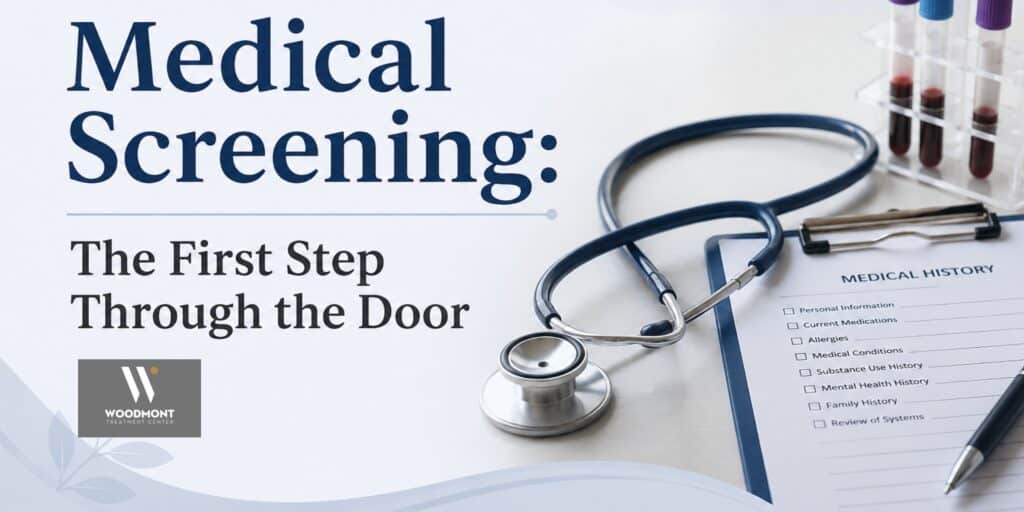
Medical Screening: The First Step Through the Door
Direct answer: Medical screening is a physical exam, bloodwork, and clinical history review completed before treatment begins, used to confirm it’s safe to start detox and to catch any complications early.
What Gets Reviewed
A physician or nurse practitioner reviews substance use history, including how much, how often, and how recently heroin or other substances were used. This determines withdrawal risk and timing.
Vital signs, bloodwork, and a physical exam follow, checking for infections, cardiac issues, and other complications common with prolonged opioid use. Co-occurring mental health conditions, depression, anxiety, PTSD, are screened for as well, since dual-diagnosis care changes the treatment plan significantly.
Why It Happens First
Skipping or rushing medical screening is how withdrawal complications get missed. A client who arrives with an undiagnosed heart condition or severe dehydration needs a different immediate plan than a healthy client starting the same detox protocol.
Medical screening isn’t a gate that has to be passed to get to “real” treatment. It is the first real treatment decision, and it shapes everything that follows.
What Happens After Screening: Intake, Step by Step
Once medical screening is complete, intake moves through a consistent sequence, usually within the first few hours of arrival.
| Step | What Happens | Typical Timing |
| 1. Medical screening | Physical exam, bloodwork, substance use history | First 1-2 hours |
| 2. Insurance and paperwork | Coverage confirmed, consent forms reviewed | Alongside screening |
| 3. Room placement | Client settles into private or semi-private en-suite | Same day |
| 4. Clinical assessment | Counselor builds initial treatment plan | Within first day |
| 5. Detox protocol begins | Medication-assisted treatment starts under supervision | Same day, if cleared |
Most of this happens within the first day. Detox protocols are then monitored around the clock for several days, with adjustments made based on how the body responds.
Withdrawal Symptoms the Medical Team Is Watching For
Heroin withdrawal typically starts within 6 to 12 hours of the last use and peaks around 48 to 72 hours in. The medical team monitors for a specific set of symptoms throughout this window.
| Timeframe | Common Symptoms |
| 6-12 hours | Anxiety, agitation, muscle aches, sweating |
| 12-48 hours | Nausea, vomiting, diarrhea, elevated heart rate |
| 48-72 hours (peak) | Intense cravings, insomnia, chills, goosebumps |
| After 72 hours | Symptoms gradually taper, though fatigue and mood changes can linger |
None of these symptoms are treated as an inconvenience to manage quietly. Medication and comfort measures are used specifically to reduce their severity, which is a large part of why medically supervised detox exists in the first place.
What Sets Smart Recovery Programs Apart
Smart recovery programs go beyond stabilizing the body. Once medical screening confirms someone is safe to begin, treatment shifts toward addressing why the addiction took hold in the first place.
This looks like individualized treatment planning built from screening results, not a generic program applied the same way to every client. Trauma-informed therapy addresses root causes rather than only managing symptoms. Holistic elements, fitness, nutrition, wellness activities, support the physical recovery happening at the same time.
Family involvement is part of this too. Once a client is medically stable, our team brings loved ones into the process through structured family communication, since recovery tends to hold better when the people at home understand what’s happening.
At Woodmont, this reflects our philosophy that we treat the person, not the disorder. Detox handles the physical piece. What comes after through our heroin treatment programs is where lasting change actually takes shape. For a closer look at what withdrawal risk can involve more broadly, our recent article on alcohol withdrawal covers similar medical monitoring principles.
What to Look for in Top Rehab Centers
Not every facility handles admission with the same level of care, and the difference shows up fast once treatment begins.
- Same-day or rapid medical screening, which reduces risk during the highest-danger withdrawal window
- 24/7 medical supervision during detox, since withdrawal complications can escalate quickly without monitoring
- Dual-diagnosis capability, because untreated co-occurring conditions often trigger relapse later
- Individualized treatment planning, since generic programs miss what’s actually driving the addiction
- Clear, direct communication about cost, which removes financial uncertainty during an already stressful time
Top rehab centers treat admission as clinical work, not paperwork. That distinction is usually visible within the first hour of walking through the door, and it’s one families searching for options across New Jersey, including Bergen County, consistently ask about during their first call.
Take the First Step Toward Recovery with Confidence
Beginning treatment doesn’t have to feel overwhelming. Our experienced clinical team will guide you through every stage of admission, from confidential assessment and medical screening to personalized treatment planning. Get the answers you need and start your recovery journey with compassionate support.
Verify Your InsuranceCost and Insurance for Admission
Most families assume treatment costs more than insurance will cover. That’s rarely accurate once benefits are actually checked.
Woodmont Heroin Treatment Center works with most major commercial insurance providers, including Aetna, Cigna, Anthem, and BCBS, and coverage can offset a significant portion, sometimes close to the full cost, depending on the plan. Private-pay options are available for clients without applicable coverage.
The only way to know actual out-of-pocket cost is to verify insurance directly, which our admissions team can confirm before you arrive, not after.
FAQ
What happens during medical screening on admission day?
A physician or nurse practitioner reviews substance use history, checks vitals, runs bloodwork, and screens for co-occurring mental health conditions before any treatment protocol begins.
How long does the full admission process take?
Most of intake, screening, paperwork, room placement, and initial clinical assessment happens within a few hours on the first day.
Will withdrawal symptoms start right away?
Heroin withdrawal typically begins within 6 to 12 hours of last use and peaks around 48 to 72 hours. Medical staff monitor closely and use medication to manage symptoms as they emerge.
Does insurance cover heroin treatment center admission and detox?
Most major commercial plans cover some or all of treatment. Our team verifies your specific benefits before your visit so there are no surprises.
Can family members be involved during the admission process?
Yes. Families are kept informed throughout intake, and once a client is medically stable, structured family communication becomes part of the treatment plan.
What if there’s an undiagnosed medical issue during screening?
That’s exactly what screening is designed to catch. The treatment plan is adjusted immediately to address any medical concern before detox protocols proceed.
Is admission handled online, or do I need to call?
Admission is managed directly by our clinical intake team by phone, not an automated booking system, so a real conversation happens before you arrive.
Is there a heroin treatment center near me in New Jersey?
Our campus sits in Newton, in Sussex County, and we work with clients from across the state, including Bergen County and the greater New Jersey area.
Do you treat co-occurring mental health conditions alongside heroin addiction?
Yes. Dual-diagnosis screening is part of admission, and integrated treatment addresses both addiction and conditions like depression, anxiety, or PTSD together.
What happens after detox is complete?
Treatment continues into therapy, aftercare planning, and relapse-prevention strategies, all built around what medical screening and clinical assessment revealed during admission.
Final Thoughts
Medical screening removes the guesswork from the most dangerous part of heroin addiction, the first days without it in your system. Knowing what admission actually involves takes away a lot of the fear that keeps people from making the call.
If you or someone you love is ready to take that step, contact Woodmont Treatment Center today for a confidential assessment, or call 1-866-348-6434 to start the intake process.