





Opioid Detox in New Jersey: What You Need to Know
Opioid detox in New Jersey is the medically supervised process of safely clearing opioids from your body — and it’s the critical first step toward lasting recovery.
Quick answers:
- What it is: A supervised program that manages withdrawal symptoms when you stop using opioids
- How long it takes: Typically 7-10 days for acute withdrawal, with symptoms peaking around 24-72 hours
- Is it safe at home? No — medical supervision is strongly recommended to prevent relapse and overdose
- What’s available in NJ: Inpatient detox, outpatient programs, and medication-assisted treatment (MAT) using medications like buprenorphine or methadone
- Does insurance cover it? Most private insurance plans cover medical detox — coverage can be verified before admission
New Jersey has been one of the hardest-hit states in the national opioid crisis. In 2016 alone, nearly 2,000 people in the state lost their lives to opioid overdose. From 2016 to 2017, New Jersey saw the largest increase in opioid overdose deaths of any state in the country — a 29.3% rise in just one year.
Fentanyl has made the crisis far more dangerous. Synthetic opioid deaths in New Jersey jumped from just 35 in 2010 to 689 in 2016. Even a tiny amount can be fatal.
For anyone caught in this crisis, the path forward starts with one thing: a safe, supported detox.
Opioid Detox in New Jersey terms you need:
The Opioid Crisis and the Need for Professional Detox
The opioid epidemic isn’t just a headline; it is a reality that has touched every corner of our state, from the busy streets of Bergen County to the quiet neighborhoods of Sussex County. Nationally, the numbers are staggering. According to HHS statistics on the national opioid epidemic, approximately 10.1 million people misused opioids in 2019 alone.
In New Jersey, the crisis evolved rapidly. Between 2010 and 2016, heroin-related deaths increased more than eight-fold. While prescription painkillers like oxycodone and hydrocodone initially fueled the fire, synthetic opioids like fentanyl have become the primary drivers of fatal overdoses. Fentanyl is roughly 50 times more potent than heroin, meaning the margin for error is non-existent.
The impact is felt most heavily in specific “hotspots.” Statistics show that opioid addiction rates are highest in Atlantic, Sussex, and Gloucester counties. In 2015, an average of 55 opioid prescriptions were written for every 100 New Jersey residents, illustrating how easily these substances entered our homes.
Commonly misused opioids include:
- Heroin (illicit)
- Fentanyl (synthetic)
- OxyContin and Percocet (oxycodone)
- Vicodin (hydrocodone)
- Morphine
- Codeine
Beyond the human toll, the CDC research on the economic impact of the opioid crisis estimates the cost to the United States at over $1 trillion annually. This includes healthcare costs, lost productivity, and the immense burden on the criminal justice system. For us in New Jersey, professional Opioid Detox in New Jersey is not just a personal necessity for those struggling; it is a critical public health intervention.
The Risks of “Cold Turkey” and Home Detox
We often hear from individuals who want to “white knuckle” their way through withdrawal at home. While the intention is brave, the reality of “cold turkey” detox is often dangerous. Opioid withdrawal is frequently described as the “lion of drugs” because of its fierce physical and psychological grip.
Stopping abruptly without medical help carries several significant risks:
- Relapse and Overdose: This is the greatest danger. When you stop using for a few days, your tolerance drops significantly. If the withdrawal symptoms become unbearable and you relapse using your “usual” dose, it can easily lead to a fatal overdose.
- Dehydration: Severe vomiting and diarrhea can lead to dangerous electrolyte imbalances.
- Psychological Distress: Intense anxiety, suicidal ideation, and depression often accompany the physical pain.
- Medical Emergencies: While opioid withdrawal itself is rarely fatal (unlike alcohol or benzo withdrawal), it can exacerbate underlying heart conditions or lead to complications like aspiration pneumonia.
Professional Opioid Detox in New Jersey provides the safety protocols and medical monitoring necessary to navigate these risks comfortably.
Understanding Opioid Detox in New Jersey
When you enter a professional program for Opioid Detox in New Jersey, you aren’t just “quitting” a drug; you are allowing your brain and body to begin a complex healing process. Opioids work by binding to receptors in the brain, flooding the system with dopamine and eventually changing how your brain perceives pain and pleasure.

Medical supervision ensures physical stabilization. Our clinical teams focus on neuroreceptor repair—helping your brain chemistry return to its natural state. This process begins with a thorough clinical assessment to determine the severity of the addiction and any co-occurring health issues. You can find more info about addiction treatment services to see how these assessments shape your journey.
The First 24 Hours of Opioid Detox in New Jersey
The first 24 hours are often the most anxiety-inducing for our clients. During this window, you will undergo a comprehensive intake process where we monitor your vital signs and establish a baseline for your health.
As the last dose of opioids leaves your system, initial withdrawal symptoms—such as restlessness, runny nose, and tearing eyes—begin to appear. This is where nursing care and comfort medications become vital. We provide nutritional support to replenish the body and focus on stabilization, ensuring you are as comfortable as possible as the acute phase begins.
Specialized Care for Opioid Detox in New Jersey
We believe that treatment should never be one-size-fits-all. Different populations face unique hurdles in recovery.
- Veterans: Many veterans struggle with chronic pain and PTSD alongside opioid use. Programs must be trauma-informed to address these overlapping issues.
- Women’s Programs: Research suggests women often progress to dependence faster than men and may use opioids to self-medicate for anxiety or trauma. Gender-specific care provides a safe space for women to build “connection,” which many experts call the “antidote to addiction.”
- Dual Diagnosis: Roughly half of those seeking rehab for opioids also struggle with a co-occurring mental health disorder like depression or bipolar disorder. Addressing both simultaneously is essential for long-term success.
Levels of Care: Inpatient, Outpatient, and MAT
Choosing the right level of care depends on your medical history, the length of your addiction, and your home environment.
| Feature | Inpatient Detox | Outpatient Detox |
|---|---|---|
| Supervision | 24/7 Medical Monitoring | Daily check-ins |
| Setting | Residential/Hospital | Home-based with clinic visits |
| Safety | Highest (prevents access to drugs) | Moderate (requires strong support) |
| Intensity | High focus on stabilization | Allows for work/school flexibility |
| Best For | Severe addiction, high relapse risk | Mild-to-moderate dependence |
For many, residential treatment provides the “clean slate” needed to focus entirely on healing. Others may benefit from ambulatory care or intensive outpatient programs (IOP) if they have a stable, drug-free home environment.
Medication-Assisted Treatment (MAT) Alternatives
MAT is considered the “gold standard” for opioid recovery. It involves using FDA-approved medications to reduce cravings and normalize brain chemistry.
- Suboxone (Buprenorphine/Naloxone): A partial opioid agonist that satisfies cravings without producing a “high.”
- Methadone: A long-acting full agonist used in highly structured clinic settings.
- Naltrexone (Vivitrol): An opioid antagonist that blocks the effects of opioids entirely, used after detox is complete.
These medications provide the long-term stability needed to engage in therapy and rebuild a life.
Transitioning to Long-Term Recovery
Detox is the foundation, but it isn’t the whole house. Transitioning to the next level of care is vital. Research shows that individuals who move directly from detox into a residential or outpatient program have significantly higher success rates.
Aftercare planning might include:
- Transitioning to a residential program for 30–90 days.
- Moving into sober living environments.
- Joining support networks like Narcotics Anonymous (NA) or SMART Recovery.
If you are ready to take this step, you can learn about our admissions process to see how we help you bridge the gap between detox and a new life.
The Withdrawal Timeline and Symptom Management
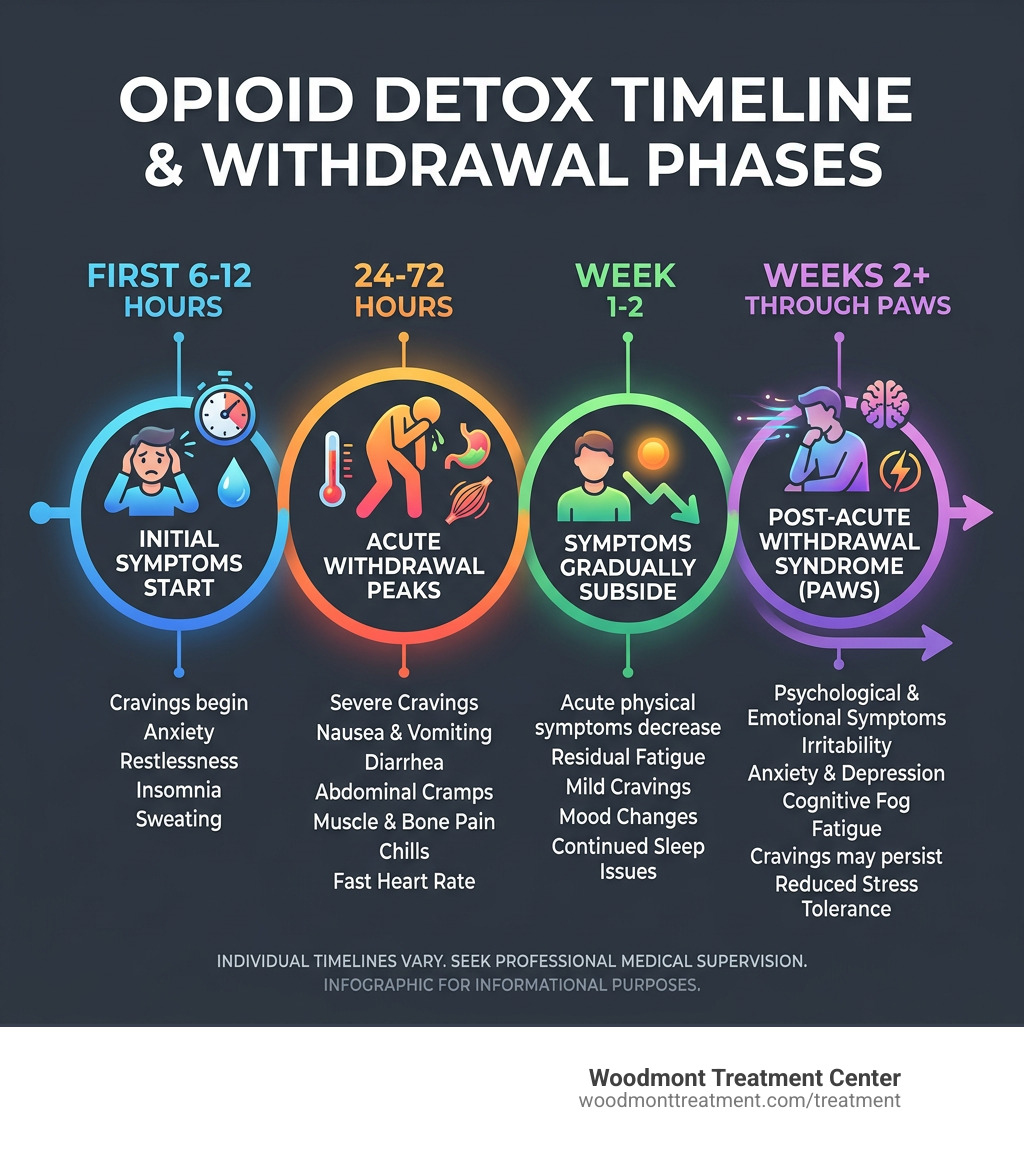
Understanding the timeline of Opioid Detox in New Jersey can help demystify the process and reduce fear.
- Early Phase (6–12 hours): Symptoms like anxiety, muscle aches, and excessive sweating begin.
- Peak Phase (24–72 hours): This is usually the most intense period. Symptoms include nausea, vomiting, diarrhea, dilated pupils, and goosebumps.
- Acute Phase Subsides (4–7 days): Physical symptoms begin to lessen, though insomnia and fatigue may persist.
- Late Symptoms (10 days+): The body begins to stabilize, but psychological cravings remain strong.
Managing Post-Acute Withdrawal Syndrome (PAWS)
Even after the physical “flu-like” symptoms vanish, many people experience Post-Acute Withdrawal Syndrome (PAWS). This protracted withdrawal can last for weeks or even months and involves:
- Mood regulation issues (irritability, depression)
- Cognitive function challenges (“brain fog”)
- Sleep disturbances
- Low stress tolerance
Managing PAWS requires ongoing psychological support and resilience building. We focus on long-term healing to ensure your brain has the time it needs to fully recover.
Holistic and Therapeutic Support Services
At Woodmont Treatment Center, we know that healing the body is only half the battle. To achieve lasting recovery from Opioid Detox in New Jersey, we must also heal the mind and spirit.
Our programs integrate evidence-based therapies with holistic practices:
- Cognitive Behavioral Therapy (CBT): Identifying and changing the thought patterns that lead to drug use.
- Dialectical Behavior Therapy (DBT): Learning emotional regulation and distress tolerance.
- Yoga and Mindfulness: Helping you reconnect with your body and stay grounded in the present moment.
- Art Therapy: Providing a creative outlet for emotions that are hard to put into words.
- Nutritional Counseling: Restoring the nutrients depleted by long-term opioid use.
- Fitness Programs: Using exercise to naturally boost endorphins and improve mood.
Choosing the Right Facility and Navigating Insurance
When searching for a facility, look for high standards of care. Accreditations from organizations like the Joint Commission ensure that the center meets rigorous safety and quality benchmarks.
New Jersey residents also have access to state-specific resources like ReachNJ (844-REACHNJ) and the 988 Lifeline for immediate crisis support. However, for those with private insurance, the process is often much simpler than expected.
Most private insurance plans cover the majority of the costs for medical detox and residential treatment. We recommend that you verify your insurance coverage before you arrive, so you can focus entirely on your recovery without financial stress.
Frequently Asked Questions about Opioid Detox
Is opioid detox painful?
While “painful” is a scary word, modern medical management makes the process much more comfortable than it used to be. We use non-narcotic comfort medications and MAT to significantly reduce symptom severity. Our goal is to make the process “uncomfortable but manageable” rather than agonizing.
How long does the detox process take?
The acute timeline for Opioid Detox in New Jersey is typically 7 to 10 days. However, individual factors—like the type of opioid used, the dosage, and your overall health—can influence this duration. Stabilization is our priority, and we don’t rush the process.
Will my insurance cover the cost of detox in New Jersey?
In most cases, yes. Most private insurance policies view detox as a medical necessity. Our admissions team handles benefit verification and works with your provider to maximize your coverage.
Conclusion
The journey through Opioid Detox in New Jersey is perhaps the most courageous step you will ever take. It is the moment you decide that your life is worth more than the substance that has been controlling it.
At Woodmont Treatment Center, we provide the evidence-based care and holistic healing necessary to build a rock-solid foundation for your future. With personalized treatment plans, luxury amenities, and a compassionate team that truly listens, we are here to guide you every step of the way.
Don’t let another day slip away to the cycle of addiction. Whether you are in Newton, Andover, or anywhere else in the Garden State, help is closer than you think. Start your journey to recovery today and reclaim the life you were meant to live.