





Drug and Alcohol Detox in Sussex County NJ: What You Need to Know First
Drug and Alcohol Detox in Sussex County NJ is the critical first step toward lasting recovery — and if you or someone you love needs help now, here’s a fast overview:
Top detox options and key facts at a glance:
| What You’re Looking For | Quick Answer |
|---|---|
| Local detox center | Woodmont Treatment Center, Newton, NJ (Sussex County) |
| How long does detox take? | 3-7 days on average |
| Does insurance cover it? | Yes — Aetna, BCBS, Medicaid, NJ FamilyCare and more |
| What follows detox? | Residential rehab, PHP, IOP, or outpatient care |
| Crisis hotline | SAMHSA: 1-800-662-4357 |
| Local recovery support | Sussex County Recovery Community Center, Newton, NJ |
Sussex County is facing a serious addiction crisis. The numbers are hard to ignore:
- 44% of all treatment admissions in Sussex County are linked to heroin
- 36% of those admitted are intravenous drug users
- 35% of admissions involve alcohol dependence
- Sussex County ranks in the top 5 counties in NJ for heroin treatment admissions, at 439 per 100,000 residents
- About 58% of adults in the county binge drink
These aren’t just statistics. They represent real people — neighbors, family members, friends — who need safe, medically supervised care.
Attempting to detox alone is dangerous. Withdrawal from alcohol, opioids, and benzodiazepines can be life-threatening without medical support. That’s why entering a professional detox program is not just recommended — it’s often essential.
This guide covers everything Sussex County residents need to know: what detox involves, how long it takes, what it costs, which insurances are accepted, and what comes next on the road to recovery.
Understanding Drug and Alcohol Detox in Sussex County NJ
When we talk about Drug and Alcohol Detox in Sussex County NJ, we are referring to more than just “quitting.” Medical detoxification is a clinically managed process that focuses on three primary goals: evaluation, stabilization, and fostering readiness for further treatment. It is the physiological “unplugging” of the body from addictive substances.
Medical Stabilization and Withdrawal Management
The first priority in any reputable Sussex County program is medical stabilization. This isn’t just about comfort; it’s about survival. For many, the brain chemistry has been fundamentally altered by long-term substance use. When the substance is suddenly removed, the central nervous system goes into a state of hyper-excitability.
At Woodmont Treatment Center, we utilize 24/7 medical supervision to monitor vital signs such as blood pressure, heart rate, and temperature. This constant oversight ensures that if a complication arises—such as a sudden spike in blood pressure or the onset of a seizure—medical professionals are on hand to intervene immediately.
The Neurobiology of Addiction
Modern addiction treatment is rooted in neurobiology. We understand that Substance Use Disorder (SUD) is a chronic brain disease, not a moral failing. Scientific research shows that chronic use of opioids or alcohol desensitizes the brain’s reward system. Detox is the beginning of “brain chemistry healing,” where we allow the neurotransmitters to begin the long journey back to homeostasis.

Safety Protocols for High-Risk Withdrawal
High-risk withdrawal scenarios, particularly involving alcohol and benzodiazepines, require stringent safety protocols. In Sussex County, where alcohol-impaired driving deaths sit at a staggering 32%, the prevalence of severe alcohol dependence is high. Our protocols are designed to prevent the most dangerous side effects of withdrawal, ensuring a transition that is as safe and “pain-free” as possible.
Common Withdrawal Symptoms and Risks
Withdrawal is a highly individualized experience, but there are common milestones. Depending on the substance, residents of Sussex County may experience:
- Nausea and Vomiting: Common in opioid and alcohol withdrawal.
- Psychological Distress: Anxiety, depression, and intense cravings are almost universal.
- Heart Rate Fluctuations: Tachycardia (fast heart rate) is a significant risk during stimulant and opioid detox.
- Seizures and Delirium Tremens (DTs): These are the most severe risks associated with alcohol and benzo withdrawal. DTs can involve hallucinations, severe tremors, and life-threatening cardiovascular collapse.
- Benzodiazepine Tapering: Because “benzos” (like Xanax or Valium) carry a high risk of seizures during withdrawal, a slow, medically managed taper is the only safe way to detox.
The Role of Medication-Assisted Treatment (MAT)
We don’t believe people should have to “white knuckle” their way through the agony of withdrawal. Medication-Assisted Treatment (MAT) is the gold standard for managing cravings and preventing relapse.
In our Sussex County programs, we utilize FDA-approved protocols including:
- Buprenorphine: Helps manage opioid withdrawal symptoms and reduces cravings.
- Naltrexone/Vivitrol: Blocks the sedative and euphoric effects of opioids and can reduce the urge to drink alcohol.
- Clinical Assessment: Every dose is preceded by a thorough assessment to ensure the medication is working effectively without causing over-sedation.
The Process and Duration of Medical Detox
One of the most frequent questions we hear is: “How long will this take?” While every person’s biology is different, there are general timelines we follow for Drug and Alcohol Detox in Sussex County NJ.
The Timeline of Drug and Alcohol Detox in Sussex County NJ
On average, the acute phase of medical detox lasts between 3 to 7 days. However, the total stabilization period can extend based on the severity of the addiction and the specific substance used.
| Substance | Start of Symptoms | Peak Intensity | Average Duration |
|---|---|---|---|
| Alcohol | 6–24 hours after last drink | 48–72 hours | 5–7 days |
| Opioids (Short-acting) | 6–12 hours after last dose | 24–48 hours | 4–7 days |
| Benzodiazepines | 1–4 days after last dose | Week 2 | Weeks to Months (Taper) |
| Stimulants | 1–3 days after last use | 3–5 days | 5–10 days |
The process begins with a comprehensive assessment. We look at your medical history, the duration of your substance use, and any co-occurring mental health issues. This allows us to create an individualized care plan that evolves as you progress through the stages of withdrawal.
Daily Life and Amenities During Detoxification
We believe that a healing environment should feel like a sanctuary, not a hospital. At Woodmont Treatment Center, our Newton, NJ facility is nestled on 10+ acres of serene landscape, providing a “homestyle retreat” feel that stands in stark contrast to traditional clinical settings.
A typical day in detox is structured to provide both rest and early therapeutic engagement:
- Morning: Vital sign checks, medication management, and a chef-prepared, nutrient-dense breakfast to help repair the body.
- Afternoon: Light individual therapy or group sessions (when the patient is physically able), along with holistic therapies like yoga or mindfulness meditation.
- Evening: Reflection, nutritional support, and rest in private or semi-private accommodations.
Our amenities include en-suite rooms, a fitness center, and gourmet meals, ensuring that your physical comfort is prioritized while your body does the hard work of detoxing.
Levels of Care and Local Recovery Resources
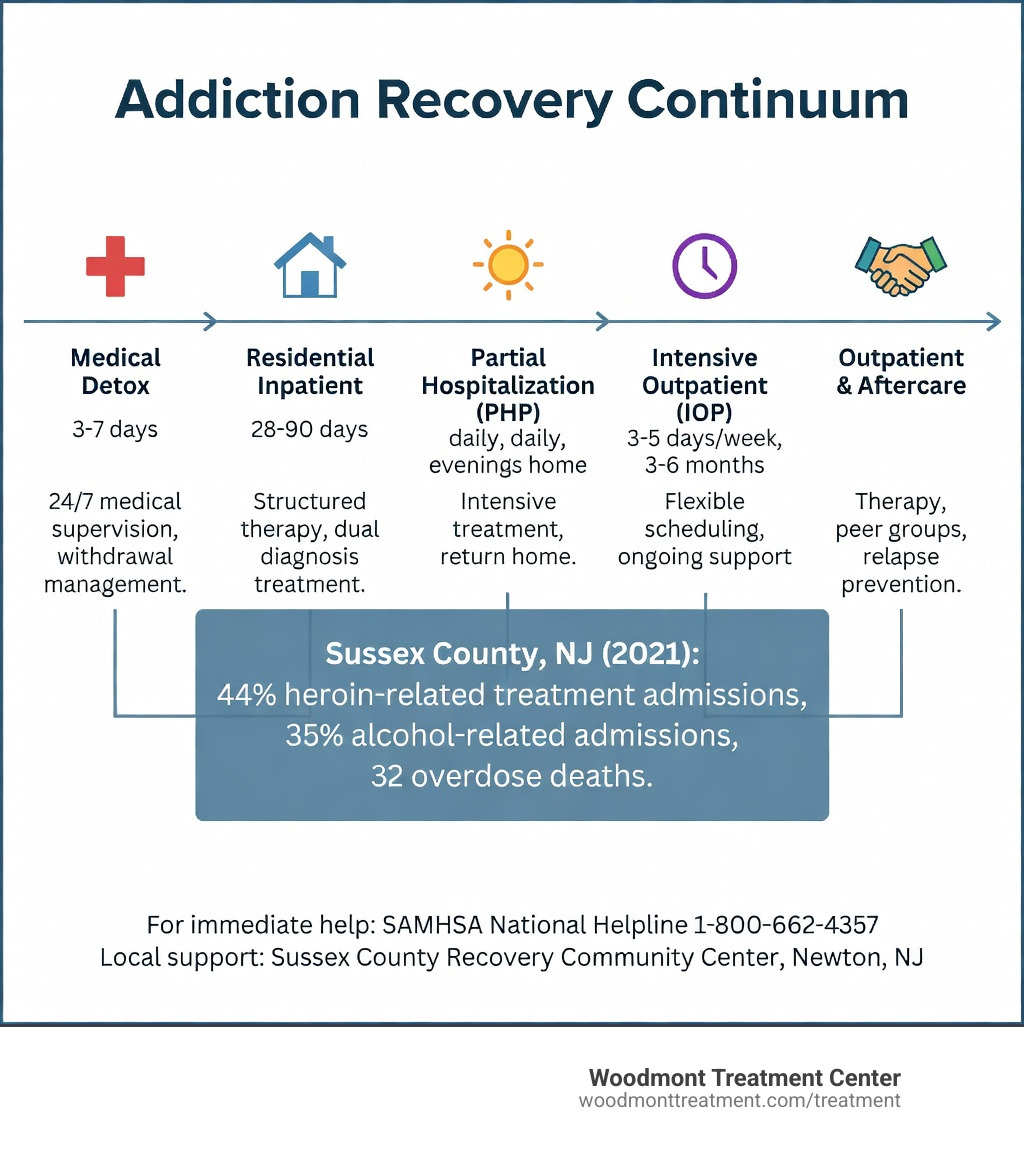
Detox is the foundation, but it is rarely the entire house. For lasting sobriety, a “continuum of care” is necessary. Once a resident of Sussex County is medically stable, we help them transition to the next appropriate level of treatment.
Transitioning After Drug and Alcohol Detox in Sussex County NJ
The risk of relapse is highest immediately following detox. To combat this, we offer several pathways:
- Residential Inpatient: This is often the recommended next step for those with long-term addictions or unstable home environments. It involves 24/7 support and intensive therapy.
- Partial Hospitalization (PHP): A “step-down” where you receive full-time treatment during the day but may return home or to a sober living environment in the evening.
- Intensive Outpatient (IOP): This allows you to maintain work or school commitments while attending therapy 3–5 days a week.
- Outpatient Care: Ongoing weekly therapy to maintain the tools learned in higher levels of care.
You can find more info about addiction treatment services on our website to see which level of care fits your current needs.
Sussex County Community Support Systems
We are proud to be part of the vibrant recovery community in Northern New Jersey. Beyond our doors, Sussex County offers incredible resources:
- Sussex County Recovery Community Center: Located at 61 Spring Street in Newton, NJ. This center provides peer recovery coaching, workshops, and a “recovery ecosystem” that supports individuals and their families. You can reach them at 973-940-2966.
- AA/NA Meetings: Newton, Andover, and Sparta host numerous weekly meetings for Alcoholics Anonymous and Narcotics Anonymous. These are free, peer-led, and essential for long-term accountability.
- SAMHSA Hotline: For immediate assistance and referrals, the SAMHSA national hotline is available 24/7 at 1-800-662-HELP.
- Local Transportation: Many local centers, including ours, can assist with transportation for admissions to ensure that “getting there” isn’t a barrier to saving your life.
Insurance Coverage and Admission for Sussex Residents
One of the biggest hurdles to seeking help is the concern over cost. However, thanks to parity laws and the Affordable Care Act, most insurance providers are required to cover substance use treatment just as they would any other medical condition.
Insurance and Costs
At Woodmont Treatment Center, we accept most major commercial insurance plans. This often means that up to 100% of your treatment costs could be covered. Common providers we work with include:
- Aetna
- BlueCross BlueShield (Horizon)
- Cigna
- UnitedHealthcare (Optum)
- NJ FamilyCare / Medicaid (for certain programs)
We encourage you to verify your insurance coverage through our secure online portal. Our admissions team will do the heavy lifting, contacting your provider to get a full breakdown of your benefits so there are no financial surprises.
The Admission Process
We’ve streamlined our admission process to be as stress-free as possible. It generally follows these steps:
- Initial Call: A confidential consultation with an admissions specialist.
- Insurance Verification: We confirm your benefits.
- Clinical Screening: A brief over-the-phone assessment to ensure we are the right fit for your medical needs.
- Arrival and Intake: You are welcomed into our facility, where a full medical and psychiatric evaluation takes place.
Dual Diagnosis and Mental Health Integration
Statistics show that approximately 50% of individuals with a substance use disorder also struggle with a co-occurring mental health condition, such as depression, anxiety, or PTSD. In Sussex County, where overdose deaths often involve multiple drugs (including Fentanyl), addressing the underlying trauma is non-negotiable.
Our “Dual Diagnosis” approach means we don’t just treat the addiction; we treat the person. During detox, we provide psychiatric evaluations and integrated psychotherapy to ensure that as the drugs leave your system, your mental health is being supported and stabilized simultaneously.
Frequently Asked Questions about Detox in Sussex County
How long does a typical detox program last in NJ?
Most residents spend 5 to 7 days in a medical detox program. However, this is not a “one size fits all” timeline. Factors like the type of substance, the amount used, and your overall physical health will determine your specific stay. For substances like benzodiazepines, a longer, medically supervised taper may be necessary to ensure safety.
Does insurance cover the full cost of medical detox?
In many cases, yes. Most private insurance plans and NJ FamilyCare cover medical detox because it is considered a “medically necessary” procedure. Depending on your specific plan (PPO vs. HMO), you may have a deductible or co-pay, but our team works hard to minimize out-of-pocket expenses.
What is the difference between medical detox and residential rehab?
Think of detox as the “emergency room” phase—it’s about immediate physical safety and clearing the body of toxins. Residential rehab is the “rehabilitation” phase—it’s where you spend 30 to 90 days learning the coping skills, trigger management, and emotional tools needed to stay sober for the rest of your life. You generally cannot have a successful rehab experience without completing detox first.
Conclusion
Taking the first step toward Drug and Alcohol Detox in Sussex County NJ is a brave decision that changes the trajectory of your entire life. Recovery is not just about stopping the use of a substance; it’s about reclaiming your self-worth, repairing your relationships, and rediscovering a life filled with meaning and fulfillment.
At Woodmont Treatment Center, we provide a tranquil, luxury environment in the heart of Newton, NJ, where you can heal your body and mind under the care of experts with over 40 years of combined experience. We treat the person, not just the disorder.
Don’t let another day pass under the weight of addiction. Whether you are seeking help for yourself or a loved one, our team is ready to guide you through every step of the journey, from the first day of detox to the lifelong support of our alumni network.
Start your admissions process today and begin the life you were meant to live.