




What You Need to Know About Alcohol Rehab in Warren County, NJ
If you’re looking for alcohol rehab in Warren County NJ, here are the most important options and resources available to you right now:
Quick Answer: Alcohol Rehab Options in Warren County, NJ
| Level of Care | What It Involves | Best For |
|---|---|---|
| Medical Detox | 24/7 supervised withdrawal | Severe physical dependence |
| Residential Inpatient | Live-in treatment, full-day programming | High-risk or unstable situations |
| Partial Hospitalization (PHP) | ~6 hours/day, 5 days/week | Step-down from inpatient |
| Intensive Outpatient (IOP) | 3-4 days/week, flexible hours | Maintaining work or family life |
| Standard Outpatient | Weekly sessions | Mild addiction or aftercare |
| Dual Diagnosis Treatment | Mental health + addiction care | Co-occurring disorders |
Key contacts:
- NJ 24/7 Addiction Helpline: 844-REACHNJ (844-732-2465)
- Warren County Addiction Services Coordinator: 908-475-6331
- Crisis/Suicide Lifeline: 988
- Uninsured? Call IME: 844-276-2777
Alcohol addiction is a serious problem in Warren County. 428 residents sought treatment for alcohol use disorder in a single year – making it the leading substance in local treatment admissions.
But here’s what most people don’t realize: the road to recovery looks very different from what you might expect. The local system is more accessible, more comprehensive, and more nuanced than a simple Google search reveals.
Whether you’re struggling yourself or trying to help someone you love, there are things about alcohol rehab in this part of New Jersey that could change how you approach getting help.
Identifying the Need for alcohol rehab in warren county nj
Recognizing that it is time to seek help can be one of the most difficult hurdles to clear. For many residents in northwestern New Jersey, the signs of alcohol use disorder (AUD) creep up slowly. You might notice a creeping tolerance, where that evening glass of wine or beer after work at a local pub in Phillipsburg or Hackettstown no longer provides the same relaxation, leading you to drink more and more to achieve the same effect.
Physical dependence is often the next “shocking” realization. If you experience withdrawal symptoms—such as shakiness, sweating, or intense anxiety—when you stop drinking for even a few hours, your body is sending a clear signal that medical intervention is necessary. Other red flags include a loss of control, where you find yourself drinking more than intended, or a priority shift, where social obligations, work performance, and family time take a backseat to obtaining and consuming alcohol.
When cravings become a constant background noise in your mind and health complications begin to surface—such as liver issues, high blood pressure, or worsening depression—it is a definitive indicator that alcohol rehab in warren county nj is the safest and most effective path forward. We often see that social isolation follows, as individuals withdraw from their communities to hide the extent of their drinking, making professional support even more vital.
1. Nearly 70% of Patients Require Dual Diagnosis Care
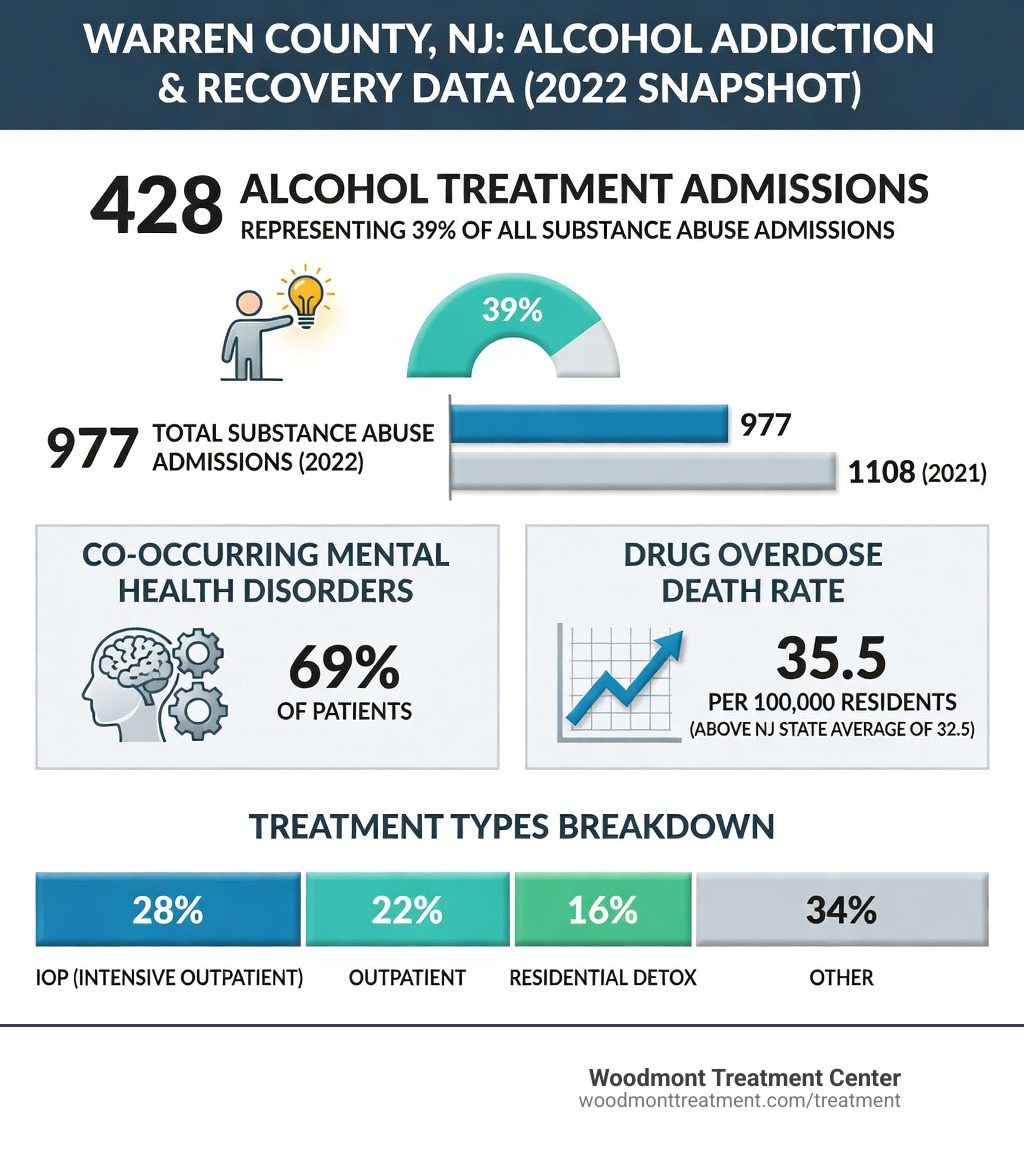
One of the most surprising statistics regarding alcohol rehab in warren county nj is the high prevalence of co-occurring disorders. According to the New Jersey Department of Human Services, a staggering 69% of those treated in Warren County (798 people) were dealing with co-occurring mental health disorders alongside their substance abuse.
This means that for the vast majority of people seeking help, alcohol is only half of the story. Mental health struggles like depression, anxiety, PTSD, and bipolar disorder are frequently intertwined with alcohol use. People often use alcohol to self-medicate underlying emotional pain or psychiatric symptoms. In 2022, there were 977 treatment admissions in 2022, and the data shows that treating only the drinking without addressing the mental health component is a recipe for relapse.
At Woodmont Treatment Center, we prioritize trauma-informed care. We understand that past experiences often fuel current addictions. Integrated treatment—where psychiatric support and addiction counseling happen simultaneously—is the gold standard. By providing a comprehensive mental health assessment alongside substance use screening, we ensure that every facet of a person’s well-being is supported.
2. Alcohol is the Leading Cause of Substance Treatment Admissions
While the national headlines often focus on the opioid crisis, in Warren County, alcohol remains a dominant force. In 2022, 428 residents were admitted for alcohol abuse disorder treatment, accounting for 39% of all treatment admissions.
To put this in perspective, alcoholism is the second most commonly abused substance in the county, right behind heroin. The sheer volume of people seeking help for alcohol is a testament to how deeply this issue affects our local communities, from the historic streets of Belvidere to the bustling centers of Hackettstown and Phillipsburg.
| Substance | 2021 Admissions | 2022 Admissions | % of Total (2022) |
|---|---|---|---|
| Alcohol | 428 | 428 | 39% |
| Heroin | 522 | 405 | 37% |
| Other Drugs | 158 | 144 | 24% |
The data from 1,108 admissions in 2021 shows that while total substance abuse admissions dropped slightly to 977 in 2022, the demand for alcohol-specific care remained steadfast. This addiction prevalence highlights the need for specialized programs that understand the unique biological and social challenges of recovering from alcohol.
3. Local Emergency Networks Provide 24/7 Crisis Support
If you or a loved one are in the midst of an alcohol-related crisis, Warren County has a robust network of emergency services designed to stabilize and protect. You don’t have to wait for an appointment to start the process of getting safe.
Local hospitals like St. Luke’s Warren Hospital in Phillipsburg and Hackettstown Medical Center are equipped to handle acute withdrawal stabilization and alcohol poisoning. These facilities are critical because alcohol withdrawal can be life-threatening if not managed by medical professionals.
Beyond physical emergencies, there are immediate lines of communication:
- National Suicide and Crisis Lifeline: Dial or text 988 for immediate mental health support.
- 211 New Jersey resource specialist: Dial 211 to be connected with local community resources and addiction services.
- Veterans Crisis Line: Veterans can dial 800-273-8255 (Option 1) for specialized support.
- State of New Jersey Narcan access: While primarily for opioids, many local programs offer Narcan training and distribution to families as part of a broader overdose prevention strategy.
These networks act as a safety net, ensuring that no resident has to face the darkest moments of addiction alone.
4. Financial Barriers are Lower for alcohol rehab in warren county nj
Many people delay seeking alcohol rehab in warren county nj because they fear the cost. However, the financial landscape of recovery is more accessible than most realize. Thanks to the Affordable Care Act, most private insurance plans are required to cover addiction treatment as an essential health benefit.
Major providers such as Aetna and Cigna are commonly accepted at high-quality facilities. Furthermore, New Jersey has made significant strides in providing options for those with lower incomes or no insurance. Medicaid covers a wide range of addiction services, and many local agencies offer a sliding scale fee structure based on your ability to pay.
For those who are completely uninsured, the state provides grant funding through the Interim Managing Entity (IME). You can call 844-276-2777 for a referral to treatment that is funded by state and federal grants. We encourage everyone to More info about insurance verification to see exactly what their policy covers. Often, the out-of-pocket costs are far lower than the mounting costs of maintaining an active addiction.
5. Recovery Extends into Warren County’s Natural Landscapes
Recovery isn’t just about what happens inside the walls of a therapy room; it’s about rediscovering a life worth living. Warren County offers some of the most beautiful natural settings in New Jersey, which serve as a perfect backdrop for holistic healing and sober activities.

Many residents find peace and clarity by visiting the Delaware Water Gap National Recreation Area or taking scenic walks along the Musconetcong River. Engaging with nature helps reduce stress and provides a healthy outlet for the energy once spent on drinking.
Local sober support is also incredibly active. There are numerous AA and NA meetings held daily throughout the county, providing a community of peers who understand the journey. For those looking for non-12-step alternatives, SMART Recovery and Dual Diagnosis Anonymous meetings are also available. Between the Spruce Run Recreation Area and local historical centers, there is no shortage of ways to build a fulfilling, alcohol-free lifestyle in northwestern NJ.
Navigating the Levels of Care in Warren County
Understanding the “continuum of care” is vital for choosing the right path. Most people don’t just “go to rehab” and come home cured; they move through different stages of support as they get stronger.
- Medical Detox: This is the first step for those with a physical dependence. It involves 24/7 medical supervision to safely manage withdrawal symptoms.
- Residential Inpatient: Patients live at the facility, receiving intensive therapy and support in a structured, “bubble” environment away from local triggers.
- Partial Hospitalization (PHP): This is a high level of care where you spend about 6 hours a day at the center but return home or to a sober living house at night.
- Intensive Outpatient (IOP): A flexible option that allows you to attend therapy sessions 3-4 days a week while maintaining your job or family responsibilities.
- Outpatient/Aftercare: Ongoing weekly therapy and support groups to maintain long-term sobriety.
We believe that a customized approach is the only way to ensure success. You can find More info about treatment services to see which level matches your current needs. Transitioning through these levels—often called “stepping down”—helps prevent the shock of returning to normal life too quickly, which is a common cause of relapse.
Specialized Programs for alcohol rehab in warren county nj
To address the complexities of addiction, modern rehabs use a variety of evidence-based practices. Cognitive Behavioral Therapy (CBT) and Dialectical Behavior Therapy (DBT) are cornerstones of our program, helping individuals identify the thought patterns that lead to drinking and develop new coping skills.
Family counseling is another critical component. Addiction is a family disease, and healing the relationships damaged by alcohol is essential for a stable home environment. We also incorporate holistic therapies—such as mindfulness, art therapy, and nutrition counseling—to treat the whole person, not just the symptoms of the disorder.
If you are ready to take the first step, you can learn More info about the admissions process. It typically starts with a confidential phone call and a comprehensive assessment to ensure you are placed in the program that gives you the best chance at a permanent “rebirth.”
Frequently Asked Questions about Alcohol Recovery
How much does alcohol rehab cost in Warren County?
The cost of alcohol rehab in warren county nj varies significantly based on the level of care required.
- Medical Detox: Typically ranges from $250 to $800 per day.
- Inpatient Residential: Can range from $5,000 to $30,000+ per month depending on amenities.
- Outpatient Programs (IOP/PHP): Generally cost between $3,000 and $10,000 for a full program.
However, most people do not pay these prices out of pocket. Private insurance, Medicaid, and state-funded grants often cover the majority of these costs. Factors that influence price include the length of stay, the intensity of medical supervision, and whether the facility is private or state-run.
Can I lose my job for attending alcohol rehab?
This is a major concern for many, but there are legal protections in place. The Family and Medical Leave Act (FMLA) allows eligible employees to take up to 12 weeks of unpaid, job-protected leave for serious health conditions, which includes addiction treatment. Additionally, the Americans with Disabilities Act (ADA) protects employees from discrimination based on their status as a person in recovery. As long as you follow your company’s formal leave request procedures, you generally cannot be fired for seeking help.
What should I bring to a treatment facility?
Every facility has its own “allow” list, but generally, you should bring:
- Comfortable clothing for 7-10 days.
- Personal toiletries (alcohol-free).
- Current prescription medications in their original bottles.
- A journal, stamps, and envelopes for writing.
- Important contact information for family and your doctor.
Most facilities restrict electronics like cell phones and laptops during the initial phases of treatment to minimize distractions and protect the privacy of other patients.
Conclusion
Recovery is possible, and it is happening every day right here in northwestern New Jersey. At Woodmont Treatment Center, we provide the high-end, evidence-based care you need to break the cycle of addiction. Our luxurious NJ facilities offer a serene environment where you can focus entirely on your healing.
From our comprehensive detox programs to our supportive aftercare, we are committed to walking with you every step of the way. If you’re ready to reclaim your life from alcohol, we invite you to reach out and get More info about starting the admissions process. Your journey to a healthier, alcohol-free future starts with a single, courageous phone call.