



Bergen County Has a Serious Addiction Problem — Here’s Where to Start
Addiction treatment in Bergen County NJ is available through a range of programs — from medical detox and inpatient care to outpatient therapy and holistic recovery options.
Here are the most important options at a glance:
- Medically supervised detox — Safe withdrawal management with 24/7 monitoring
- Residential inpatient programs — Structured, intensive care for severe addiction
- Holistic therapies — Mind-body approaches like Qigong, yoga, and mindfulness
- Behavioral therapies (CBT & DBT) — Evidence-based counseling for lasting recovery
- Medication-Assisted Treatment (MAT) — FDA-approved medications like Suboxone and Vivitrol
Bergen County is home to over 1,293 substance abuse treatment admissions recorded in 2022 alone. Alcohol, heroin, and marijuana are the most common substances driving people to seek help. And nearly two-thirds of those seeking treatment also live with a co-occurring mental health condition like depression, anxiety, or PTSD.
That’s a lot of people carrying a heavy load — often in silence.
The good news: Bergen County has real resources. County programs, medical centers, and private treatment facilities offer a full continuum of care. Whether you’re just starting to ask questions or ready to take the next step, understanding your options is the most important first move.
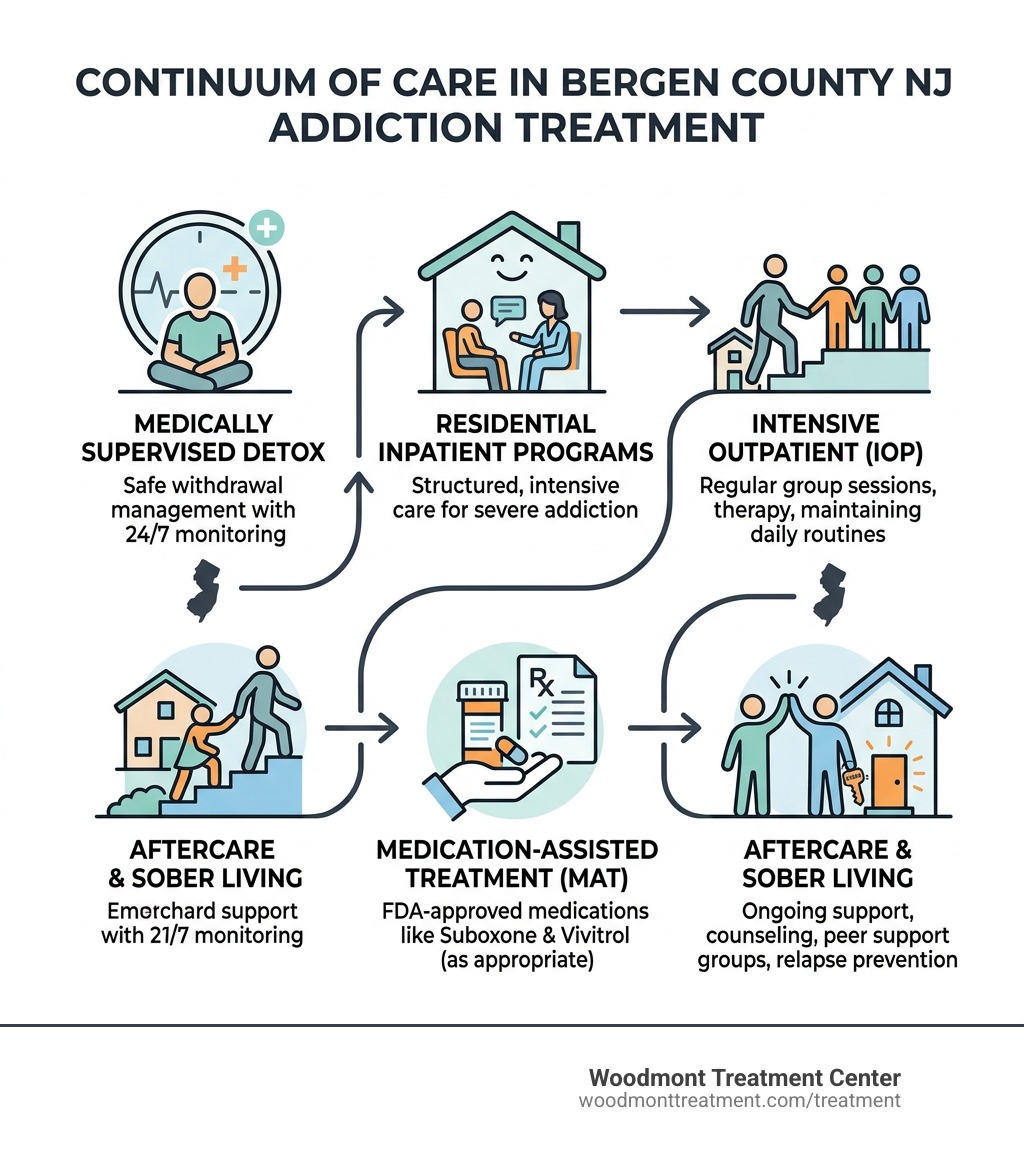
Addiction Treatment in Bergen County NJ terms made easy:
- Alcohol Rehab In Passaic County New Jersey
- Alcohol Rehab in Hunterdon County NJ
- Drug Rehab in Sussex County New Jersey
Understanding Addiction Treatment in Bergen County NJ

When we look at the landscape of Addiction Treatment in Bergen County NJ, we see a community that is both deeply affected and highly resilient. Recent data shows that the struggle is real: in 2021, there were 1,239 admissions for substance use, a number that climbed to 1,293 by 2022.
Alcohol remains the primary substance cited in these admissions, accounting for roughly 42% of cases, followed closely by heroin (31%) and marijuana (9%). However, the statistics tell a deeper story than just substance types. Approximately 71% of those seeking help are male, and a staggering 64% struggle with a co-occurring mental illness. This means that for the majority of residents, addiction isn’t walking alone—it’s often accompanied by depression, anxiety, or trauma.
In New Jersey, there is a recognized gap in resources, with only about 72.7% of the state’s mental health professional needs currently being met. This makes it even more vital to find a facility that offers integrated care. If you are looking for immediate help or want to understand the broader state-wide initiatives, you can explore the Scientific research on New Jersey drug addiction resources.
The 5 Best Treatment Modalities for Lasting Recovery
Recovery isn’t a one-size-fits-all t-shirt. It’s more like a custom-tailored suit. To achieve long-term sobriety, we believe in using a multidisciplinary team approach that combines evidence-based science with holistic wellness. Here are the five most effective modalities currently used in top-tier Addiction Treatment in Bergen County NJ.
1. Medically Supervised Detox and Withdrawal Management
The first step is often the hardest, but it’s also the most critical. Withdrawal management is the process of helping your body safely clear substances while managing the physical and psychological symptoms that follow.
In a professional setting, this usually lasts between 5 to 7 days. During this time, you receive 24/7 medical monitoring and pharmacological support to ensure you stay stable. Attempting to “white-knuckle” detox at home can be dangerous, especially with alcohol or benzodiazepines. Professional stabilization sets the foundation; research shows that short-term success in detox significantly increases the likelihood of a person sticking with their long-term recovery plan. You can find More info about treatment services to see how these clinical steps fit into a larger plan.
2. Residential Inpatient Programs for Intensive Care
Sometimes, you just need to get away from the “people, places, and things” that trigger use. Residential programs provide a highly structured, safe environment where the focus is 100% on healing.
Many intensive programs in our area follow a 21-day to 90-day cycle. These programs are particularly effective because they offer:
- Trauma-informed care: Addressing the “why” behind the addiction.
- 24-hour supervision: Ensuring safety and preventing relapse during the most vulnerable early weeks.
- Peer support: Living with others who truly understand the struggle.
3. Holistic Approaches and Mind-Body Therapies
We’ve learned that treating only the physical addiction often leads to a “dry drunk” scenario—where the person isn’t using but is still miserable. Holistic rehab addresses the emotional roots of addiction.
Practices like Qigong are becoming a staple in Addiction Treatment in Bergen County NJ. By balancing the body’s “chi” (energy), Qigong helps patients manage the daily stressors that often lead back to substance use. Other holistic tools include:
- Mindfulness and Yoga: To reconnect the mind and body.
- Nutritional Support: Healing the gut and brain after years of substance-related damage.
- Art and Music Therapy: Providing a non-verbal outlet for complex emotions.
4. Evidence-Based Behavioral Therapies (CBT & DBT)
If detox handles the body, behavioral therapy handles the brain. Cognitive Behavioral Therapy (CBT) and Dialectical Behavior Therapy (DBT) are the gold standards of psychotherapy.
- CBT helps you identify and change the negative thought patterns that lead to self-destructive behaviors.
- DBT focuses on emotional regulation and distress tolerance—basically teaching you how to handle a “bad day” without reaching for a bottle or a needle.
These therapies are essential for building the coping skills necessary for relapse prevention.
5. Medication-Assisted Treatment (MAT)
For those struggling with opioid use disorder or severe alcoholism, MAT can be a lifesaver. It involves the use of FDA-approved medications like Suboxone or Vivitrol alongside traditional counseling.
MAT works by normalizing brain chemistry, blocking the euphoric effects of opioids, and relieving physiological cravings. It’s not “replacing one drug with another”; it’s a medical tool used to stabilize the brain so the patient can actually focus on their therapy and long-term goals.
Navigating Levels of Care: Inpatient vs. Outpatient
Choosing the right level of care is a clinical decision usually based on the ASAM (American Society of Addiction Medicine) criteria. This looks at your medical history, the severity of your addiction, and your home environment.
| Feature | Inpatient / Residential | Outpatient (IOP/PHP) |
|---|---|---|
| Supervision | 24/7 Medical & Clinical | Scheduled sessions (9-30 hrs/week) |
| Environment | Controlled, facility-based | Home-based with clinic visits |
| Best For | Severe addiction, dual diagnosis | Mild/moderate addiction, step-down care |
| Duration | 21 – 90 Days | 8 weeks to several months |
| Work/School | Requires a leave of absence | Can often be maintained |
To learn more about how we determine the right fit for you, check out More info about the admissions process.
Benefits of Outpatient Addiction Treatment in Bergen County NJ
For many residents, life doesn’t stop just because they need help. Outpatient programs, including Intensive Outpatient (IOP) and Partial Hospitalization (PHP), offer the flexibility to receive high-level care while staying connected to your family and job.
The unique benefit of outpatient care is the “real-world” application. You can learn a coping skill in a morning group session and practice it that very evening at home. This immediate integration can be incredibly powerful for long-term habit change.
When to Choose Inpatient Addiction Treatment in Bergen County NJ
Inpatient care is usually recommended if you have:
- A high risk of severe withdrawal (delirium tremens or seizures).
- A co-occurring disorder (dual diagnosis) that requires psychiatric stabilization.
- A home environment that is unsupportive or “toxic” to recovery.
- History of multiple relapses in outpatient settings.
Accessing County Resources and Support Systems
Bergen County is unique because of its robust government and community-led initiatives. The Bergen County Division of Mental Health & Addiction Services plays a massive role in planning and oversight, ensuring that residents have access to care regardless of their ability to pay.
- 262-HELP: This is the county’s psychiatric emergency screening service.
- 988: The national suicide and crisis lifeline.
- Municipal Alliances: Local volunteer groups focused on prevention and education in your specific town.
- Overdose Fatality Review Team (OFRT): A specialized team that analyzes overdose deaths to recommend systemic changes to save lives.
For families who are suffering alongside their loved ones, there is Support for families via Al-Anon, as well as Nar-Anon and Families Anonymous. These groups provide a space to process the “family disease” of addiction.
Specialized Programs for Diverse Populations
We know that a veteran’s journey is different from a teenager’s, and a member of the LGBTQ+ community faces unique stressors that others might not.
- Teens: Early intervention programs (often 8 weeks) help adolescents navigate peer pressure and emotional regulation before a “habit” becomes a full-blown disorder.
- Veterans/First Responders: Programs focusing on PTSD and occupational trauma.
- LGBTQ+: Gender-affirming care and stigma-free environments are essential for safety and healing.
Frequently Asked Questions about Recovery in NJ
Does insurance cover addiction treatment in Bergen County?
Yes, most private insurance plans (Aetna, Cigna, BlueCross BlueShield) are required by law to cover substance abuse treatment. Many local facilities also accept Medicaid, Medicare, and NJ FamilyCare. It is always best to verify your specific benefits before admission.
How long does a typical rehab program last?
There is no “standard” time, but most research suggests that better outcomes are tied to longer durations. Programs can range from a 5-day detox to a 21-day residential stay, or several months of outpatient care.
What are co-occurring disorders and how are they treated?
A co-occurring disorder (or dual diagnosis) is when someone has both a mental health issue (like Bipolar or PTSD) and a substance use disorder. In Bergen County, 64% of patients fall into this category. They are best treated through “integrated care,” where both conditions are addressed simultaneously by the same clinical team.
Conclusion
Finding the right Addiction Treatment in Bergen County NJ doesn’t have to be an overwhelming maze. Whether you need the 24/7 safety of an inpatient unit or the flexibility of an outpatient program, the goal is the same: a return to your “best self.”
At Woodmont Treatment Center, we provide that full spectrum of care—from medically supervised detox and residential programs to personalized aftercare. Our approach is rooted in evidence-based science but delivered with the warmth and holistic care you deserve. We believe that recovery shouldn’t be a “drag”—it should be a transformative experience that helps you reclaim your life.
If you’re ready to see what your options look like, the first step is simple. Verify your insurance coverage today and let us help you map out your journey to wellness. You don’t have to do this alone.