



The Unique Challenges Faced by Frontline Heroes
First responder treatment programs are specialized rehab programs designed for police officers, firefighters, paramedics, EMTs, dispatchers, and corrections officers who are struggling with addiction, PTSD, or co-occurring mental health conditions.
What to look for in a first responder treatment program:
- Trauma-informed care that addresses occupational trauma and PTSD alongside addiction
- Confidentiality protections under HIPAA and 42 CFR Part 2, with no automatic employer notification
- Peer support from fellow first responders and culturally competent clinical staff
- Co-occurring disorder treatment for dual diagnosis conditions like PTSD and alcohol use disorder
- Flexible program levels including residential, intensive outpatient (IOP), and step-down aftercare
- Insurance coverage through most major commercial plans, TRICARE, and workers’ compensation
Every shift, first responders walk into situations most people will never face. Over time, that exposure builds up.
The statistics paint a stark picture. Up to 30% of first responders develop behavioral health conditions like PTSD or depression. Nearly one in three will experience post-traumatic stress. And up to 40% are affected by alcohol abuse — often beginning as a way to decompress after a brutal shift and quietly becoming something much harder to manage.
Perhaps most alarming: first responders are more likely to die by suicide than in the line of duty.
These numbers aren’t just statistics. They represent real people — paramedics who can’t sleep, officers who feel nothing, firefighters whose marriages are falling apart — who are struggling in silence because asking for help feels like a threat to everything they’ve worked for.
At Woodmont Treatment Center, we understand that the path forward requires more than a standard rehab program. We provide specialized care that knows the culture, respects the sacrifice, and treats the whole person. If you are a first responder in Sussex County, Warren County, or surrounding areas, contact Woodmont Treatment Center today to access the dedicated support you deserve.
To understand why specialized care is so vital, we first have to look at the daily realities of frontline service in New Jersey. Whether you are patrolling the streets of Bergen County, responding to structural fires in Newton, or managing high-stress emergency dispatches in Warren County, the weight of the job is relentless. The 24-hour shift cycle doesn’t reset when you go home.
First responders are repeatedly exposed to critical incidents, mass casualties, and life-threatening situations. This cumulative exposure leads to a unique set of clinical challenges:
- Post-Traumatic Stress Disorder (PTSD) & Depression: Approximately 22% of first responders develop PTSD from critical incidents — a rate up to four times higher than the general population.
- Hypervigilance: The constant “red alert” state required on duty does not simply switch off. This chronic state of nervous system arousal makes rest, digestion, and emotional connection nearly impossible at home.
- Severe Sleep Disruption: Shift work, overnight calls, and high-stress deployments systematically destroy healthy sleep architecture.
- Moral Injury: Distinct from fear-based PTSD, moral injury occurs when frontline personnel witness or must participate in situations that deeply violate their core beliefs and ethical values. It manifests as intense shame, guilt, and spiritual distress.
When these challenges pile up, many heroes feel isolated. Local community resources, such as the Sussex County Recovery Community Center, offer wonderful general support, but first responders often require a deeper level of clinical intervention to safely navigate their occupational wounds.
The Intersection of Trauma and Substance Use
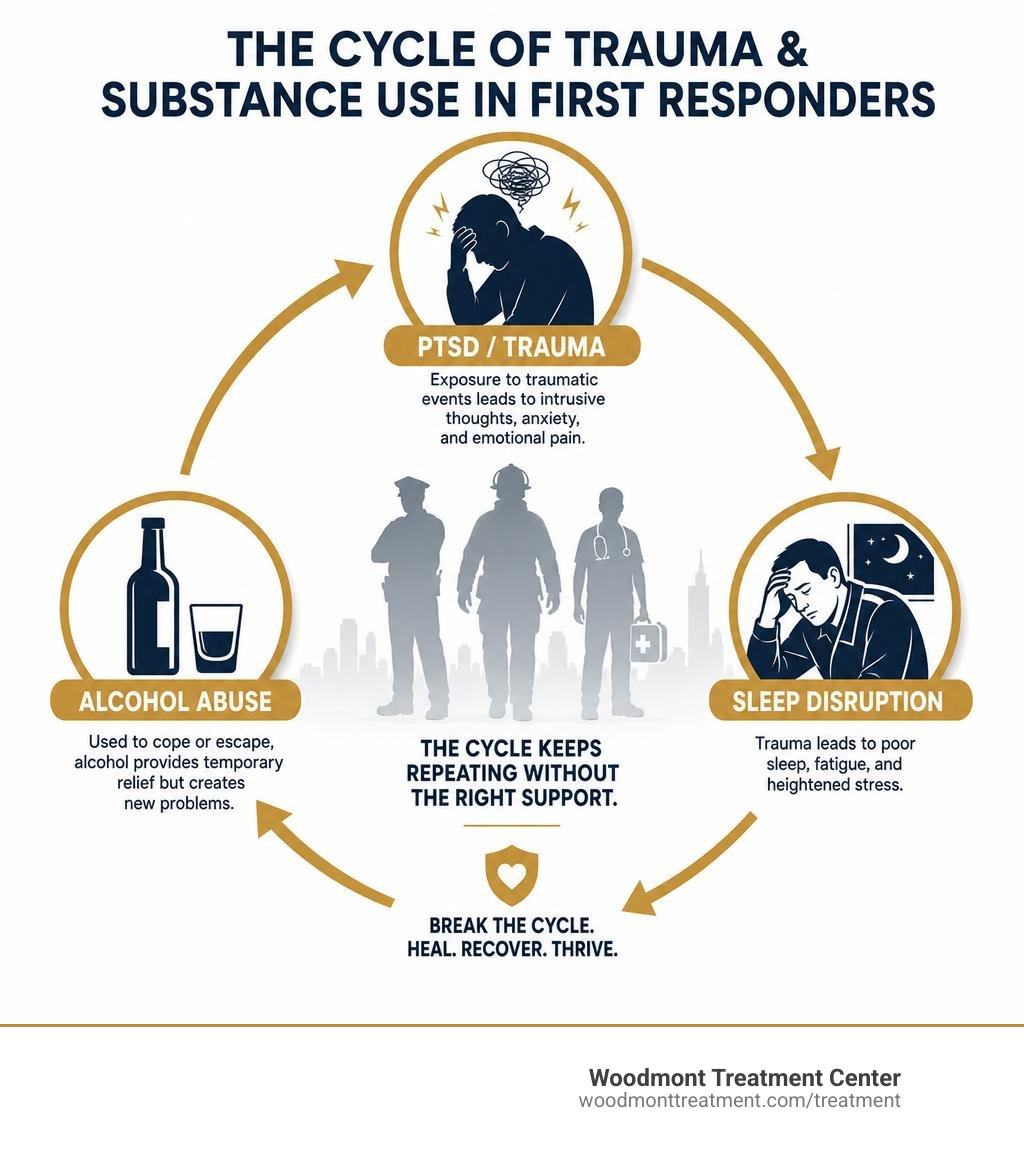
In our clinical experience, substance use among emergency personnel rarely starts as recreational. Instead, it begins as a functional coping mechanism. When your nervous system is screaming from hypervigilance and you haven’t slept deeply in weeks, a few drinks can feel like the only way to “turn off the engine.”
This self-medication creates a dangerous cycle. Alcohol and drugs temporarily dull the pain, but they ultimately disrupt sleep further, worsen depression, and lower the threshold for PTSD flashbacks. Before long, a co-occurring disorder develops, where the trauma and the addiction feed into one another.
To break this cycle, treatment must address both conditions simultaneously. Attempting to treat substance use without addressing the underlying trauma is like painting over rust; it may look better for a moment, but the structural issue remains. For a comprehensive look at how clinical teams address these dual diagnoses, read An Essential Guide to Evidence-Based Inpatient Rehab.
Barriers to Seeking Help in Public Safety
If first responders struggle at such high rates, why do so few raise their hands for help? The answer lies in the deeply ingrained “warrior ethos” of public safety culture.
Emergency personnel are trained to be the helpers, not the ones needing help. Admitting to a struggle is often mistakenly viewed as a sign of weakness or a lack of fitness for duty. Furthermore, the fear of professional repercussions is incredibly real. Many officers, firefighters, and medics worry that seeking mental health treatment will lead to:
- Loss of their badge, gun, or active status.
- A breach of confidentiality that exposes their struggles to command staff or peers.
- Damage to their reputation and the loss of the trust of their unit.
- A feeling of having broken the public trust.
These barriers mean that by the time a first responder actually enters treatment, they are often in a state of severe crisis. That is why we must build a bridge of absolute safety, discretion, and specialized understanding.
Why Traditional Rehab Falls Short: The Need for First Responder Treatment Programs
Many well-meaning, traditional civilian rehab programs simply fall short when treating frontline professionals. When a police officer or firefighter sits in a general therapy group, they face unique safety and cultural barriers.
For example, a law enforcement officer may feel forced to use a false identity or hide their profession due to hostility or anti-police sentiment from other group members. Conversely, a civilian in the group may be traumatized just by hearing a firefighter describe a horrific multi-vehicle accident. This creates an environment where the first responder cannot speak honestly, preventing genuine healing.
Specialized first responder treatment programs solve this problem by creating an exclusive, culturally competent sanctuary.
| Feature | Traditional Civilian Rehab | First Responder Treatment Programs |
|---|---|---|
| Peer Group Composition | General public; diverse backgrounds | Exclusively frontline personnel & veterans |
| Clinical Focus | General coping; standard relapse prevention | Trauma-informed; PTSD & moral injury integration |
| Staff Competence | General addiction credentials | Culturally trained in public safety stressors |
| Career Protection | Standard HR/FMLA support | Direct coordination with EAPs, unions, & duty return |
| Nervous System Work | Standard group therapy schedules | Focus on sleep restoration, hypervigilance, and somatic release |
The Power of Peer Support in First Responder Treatment Programs
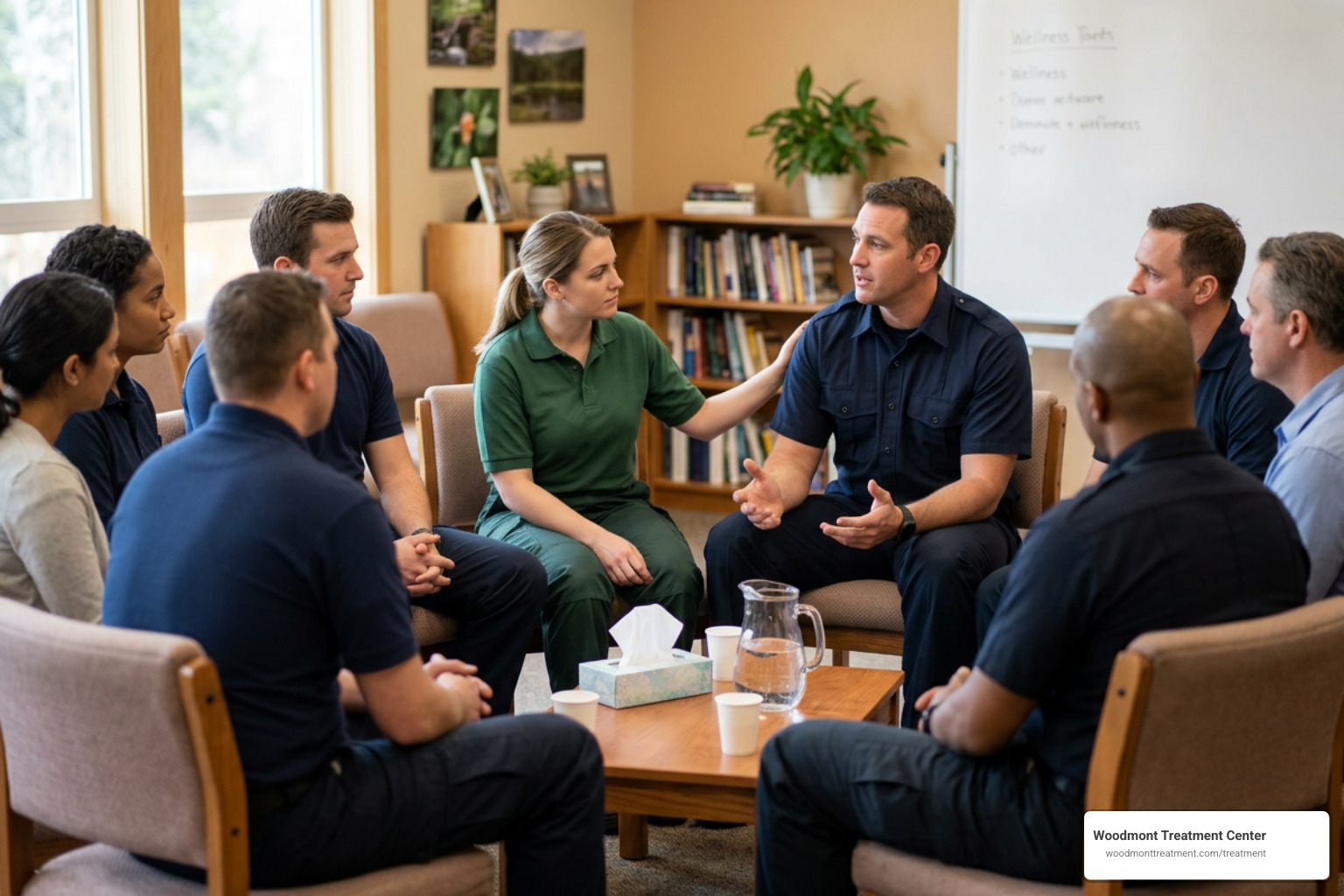
There is an unspoken language among those who wear a uniform. The shared experiences of the firehouse kitchen, the patrol car, or the dispatch desk build a unique foundation of mutual trust.
In a specialized program, peer support acts as a powerful clinical catalyst. When you sit in a circle with others who have also carried the weight of a line-of-duty death or the quiet guilt of a bad call, the walls of isolation crumble. You don’t have to explain the jargon, and you don’t have to worry about being judged.
This sense of solidarity helps reframe recovery not as a punishment, but as a team effort to rebuild resilience. Organizations like Responders First — Activating Post-Traumatic Growth emphasize that healing happens when we turn shared pain into shared strength.
The Role of Scenic and Peaceful Environments in Recovery
When your daily life is defined by sirens, flashing lights, and chaotic streets, the physical environment in which you recover matters deeply. Trying to heal in a sterile, institutional setting can trigger the same feelings of confinement and coldness that first responders associate with crisis scenes.
A peaceful, nature-based environment acts as a natural balm for an overworked nervous system. Rolling hills, quiet woods, and fresh air help lower cortisol levels and allow the body to shift out of “fight-or-flight” mode.

At Woodmont Treatment Center, located in the beautiful landscapes of Sussex County, NJ, we prioritize this natural healing process for first responders from Sussex County, Warren County, and across New Jersey. Our peaceful surroundings allow clients to rest, sleep deeply, and process their trauma without the constant buzz of urban triggers. If you are a local first responder ready to heal in a supportive, non-clinical environment, contact Woodmont Treatment Center today. To explore the benefits of healing in a serene setting, see The Best Luxury Rehab Facility NJ Has for Upscale Healing.
Evidence-Based Therapies Tailored for Frontline Trauma
To help first responders recover, we utilize a suite of highly effective, evidence-based therapies. These are not passive “talk therapies” that force you to endlessly replay traumatic events. Instead, they are active, structured modalities designed to reprocess memories and reset the nervous system.
- Eye Movement Desensitization and Reprocessing (EMDR): EMDR is a gold-standard treatment that uses bilateral stimulation (such as guided eye movements) to help the brain reprocess traumatic memories. It allows you to file those memories away in a healthy way, so they no longer trigger intense emotional or physical distress in the present.
- Accelerated Resolution Therapy (ART): ART is one of the fastest-acting trauma treatments available, often showing measurable results in just 1 to 5 sessions. It allows clients to reprocess traumatic images and memories internally, without even having to verbalize the painful details aloud if they prefer not to.
- Cognitive Behavioral Therapy (CBT) & Dialectical Behavior Therapy (DBT): These therapies help identify destructive thinking patterns (like survivor’s guilt) and replace them with healthy, active coping mechanisms.
- Somatic and Mindfulness Therapies: Techniques like trauma-sensitive yoga and iRest (Integrative Restoration) focus on regulating the physical body, helping to restore healthy sleep architecture and reduce physical tension.

Addressing Co-occurring PTSD and Addiction
True recovery requires a dual-diagnosis approach where mental health conditions and substance use are treated in parallel, not sequentially.
When a first responder enters our care, we begin with a thorough evaluation to map out their unique psychological and physical needs. For those struggling with severe physical dependence, we provide a safe, medically supervised detoxification process to manage withdrawal symptoms comfortably and privately. From there, we integrate trauma stabilization directly with addiction counseling, ensuring that as you build relapse prevention skills, you are also healing the wounds that drove the substance use in the first place. You can Learn more about our specialized conditions treatment to see how we build these integrated paths.
Family Therapy and Reintegration Strategies
The trauma of emergency service is rarely confined to the person in uniform. Spouses, partners, and children often carry the weight of “secondary trauma.” They experience the emotional distance, the sudden mood shifts, and the chronic worry that comes with the job. It is a sobering reality that 60% to 75% of first responders’ marriages end in divorce.
Because of this, family involvement is a core pillar of our program. We offer family education workshops and dedicated therapy sessions to help loved ones understand the mechanics of PTSD and addiction. Together, we work to rebuild trust, establish healthy boundaries, and improve communication.
Furthermore, we focus heavily on return-to-work planning. Whether your goal is a safe return to active duty or a healthy transition to a new chapter of service, we work closely with you to ensure you have the tools, ongoing support, and coping mechanisms needed to face the daily grind without falling back into old patterns. For an overview of what this journey looks like, read What to Expect at an Inpatient Addiction Rehab Center.
Navigating Confidentiality, Insurance, and Admissions
The logistics of entering rehab can feel overwhelming, especially when you are worried about your career. We want to make this process as clear, private, and stress-free as possible.
First and foremost, your privacy is protected by strict federal laws. The Health Insurance Portability and Accountability Act (HIPAA) and 42 CFR Part 2 provide enhanced confidentiality protections for substance use treatment. This means that your treatment records, and even the fact that you are in treatment, cannot be shared with your department, union, or anyone else without your explicit, written consent.
For local resources and municipal support programs in our area, you can also explore the Warren County Addiction Services Programs, which work alongside private providers to ensure community members have access to care.
Protecting Your Career and Privacy in First Responder Treatment Programs
Seeking help is not a career-ending decision; in fact, it is often what saves a career. Under the Family and Medical Leave Act (FMLA) and the Americans with Disabilities Act (ADA), your job is legally protected while you receive medical treatment for addiction or mental health conditions.
We regularly coordinate with Employee Assistance Programs (EAPs) and union representatives—always with your consent—to navigate fitness-for-duty evaluations and return-to-service documentation. Our goal is to protect both your health and your livelihood. To learn more about how high-quality facilities manage 24-hour admissions and immediate, private intakes, see The 10 Best 24-Hour Addiction Care Centers.
Insurance Coverage and Financial Assistance Options
Many first responders worry about the cost of care. Thanks to federal mental health parity laws, most major commercial insurance plans are required to cover mental health and substance use treatment at the same level they cover traditional medical care.
At Woodmont Treatment Center, we are in-network with many major commercial insurance providers. We handle the entire verification process for you, communicating directly with your insurance company to maximize your benefits and minimize any out-of-pocket costs. If you are looking for a program that allows you to receive high-level care while maintaining your daily life and family connections in New Jersey, you can Explore our intensive outpatient program options.
Frequently Asked Questions about First Responder Rehab
Will my department find out if I seek treatment?
No. Under federal confidentiality laws (HIPAA and 42 CFR Part 2), your treatment is entirely private. We cannot and will not notify your employer or department that you are in rehab unless you provide us with explicit, written authorization to do so.
How long do these specialized programs typically last?
Treatment plans are fully customized to the individual. Residential programs typically range from 30 to 90 days, depending on the severity of the trauma and substance use. Many clients then step down to an intensive outpatient program (IOP) to transition smoothly back into daily life. To understand the benefits of longer-term care, read about The 5 Best Long-Term Residential Rehabilitations.
Can my family be involved in my recovery process?
Absolutely. We strongly encourage family participation. Through family therapy sessions and educational workshops, we help your loved ones understand the nature of occupational trauma and addiction, providing a supportive environment for the entire family to heal together.
Finding Hope and Healing in New Jersey
At Woodmont Treatment Center, we believe that those who spend their lives protecting our communities deserve the highest standard of care when they are the ones in need.
Located in the peaceful, scenic surroundings of Sussex County, NJ, our facility offers a luxurious, non-institutional environment designed to feel like a retreat. Led by a team of highly experienced, culturally competent clinicians, we combine evidence-based therapies with deep peer support to help you reclaim your life, your relationships, and your career. We proudly serve first responders throughout Sussex County, Warren County, and the surrounding regions.
You have carried the weight of your community for long enough. It is okay to put it down and let us help you carry it.
If you or a loved one is a first responder in Sussex County or Warren County struggling with trauma, PTSD, or substance use, please reach out to Woodmont Treatment Center today. Your call is completely confidential, and our team is ready to walk with you every step of the way. Begin your recovery journey today and take the first step toward post-traumatic growth.