





Warren County Residents: Get Detox Help Now to Start Recovery Safely
Drug and Alcohol Detox in Warren County NJ is the critical first step toward lasting recovery — and if you or someone you love needs help right now, here’s what’s available:
Quick answers for Warren County residents seeking detox:
- Call Woodmont Treatment Center to speak with a detox specialist: available 24/7 to help Warren County residents start today
- Medical detox programs typically last 5-7 days with round-the-clock supervision
- Insurance accepted: Medicaid, Medicare, and most private plans cover detox
- Levels of care available: Inpatient detox, outpatient detox, PHP, IOP, and aftercare
- Emergency help: Call 988 (crisis line) or 211 NJ (resource specialist) for immediate support
Warren County, NJ — home to communities like Phillipsburg, Hackettstown, and Washington — has been hit hard by the substance abuse crisis. In 2022 alone, the county recorded 977 treatment admissions. Between 2017 and 2019, there were 343 overdose cases, with Naloxone administered over 500 times just to keep people alive.
Heroin accounts for 40% of treatment admissions. Alcohol accounts for 32%. And 36% of those entering treatment were intravenous drug users.
These aren’t just numbers. They represent real people — neighbors, parents, friends — who needed help and didn’t always know where to turn.
Detox is not the same as rehab. It’s the process of safely clearing substances from your body under medical supervision so withdrawal doesn’t become life-threatening. Without it, many people can’t even get to the next stage of recovery.
If you’re a Warren County resident ready to take that first step, Woodmont Treatment Center is here to help. Call us today to find out how we can get you started.
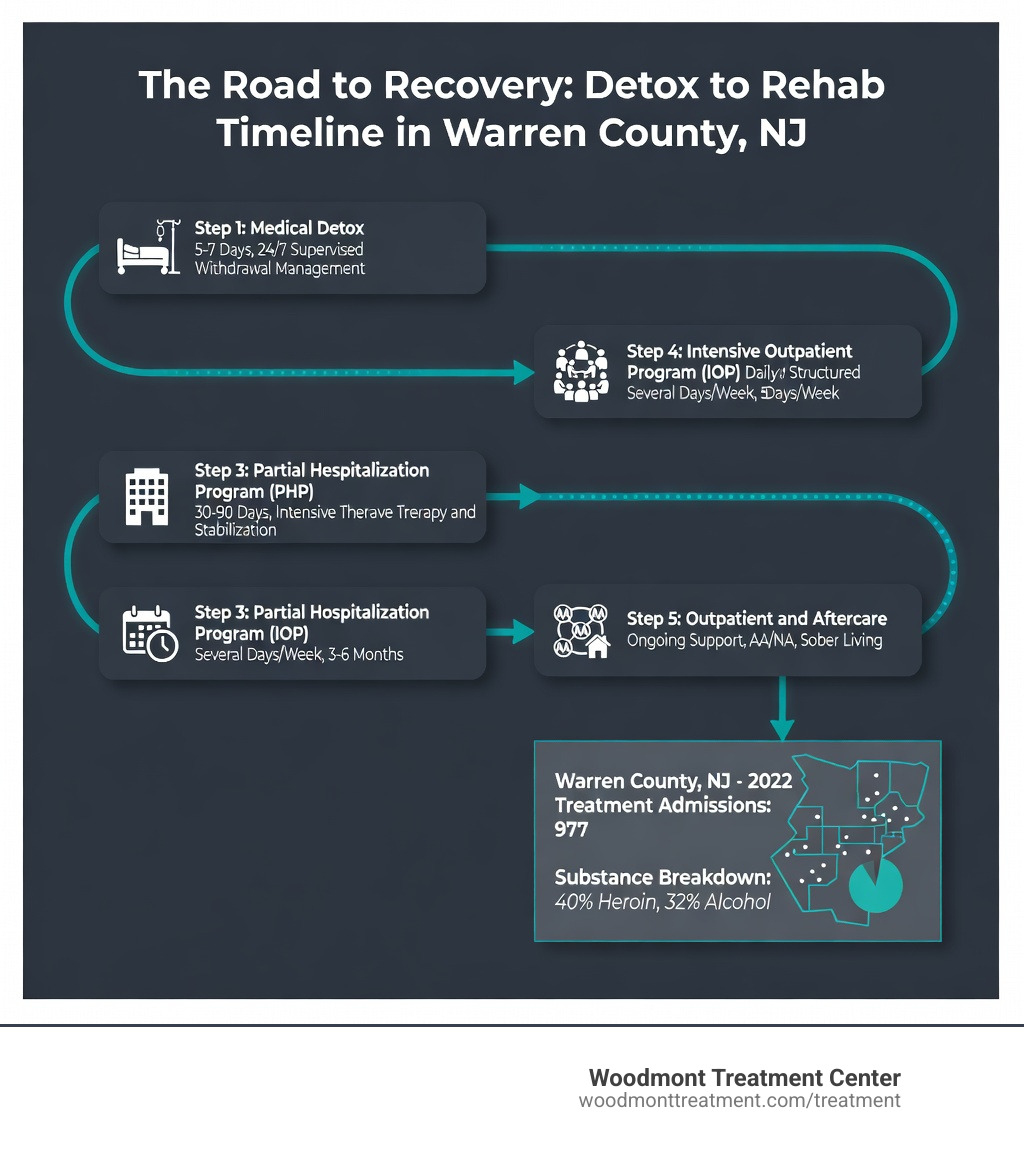
Simple guide to *Drug and Alcohol Detox in Warren County NJ *:
Understanding Drug and Alcohol Detox in Warren County NJ
When we talk about Drug and Alcohol Detox in Warren County NJ, we are referring to the physiological process of removing toxins from the body. For many of our neighbors in Phillipsburg or Hackettstown, this is the “make or break” moment. Addiction changes the way your brain and body function; when you suddenly stop using a substance, your system goes into a state of shock. This is known as withdrawal.
The Risks of “Cold Turkey” or Home Detox
We often hear from families in Warren County who wonder if they can just manage detox at home. While the intention is good, the risks are incredibly high. Without medical supervision, withdrawal from substances like alcohol or benzodiazepines can lead to:
- Seizures: Often occurring without warning and potentially fatal.
- Severe Dehydration: Caused by vomiting and diarrhea, which can lead to organ failure.
- Delirium Tremens (DTs): A severe form of alcohol withdrawal involving hallucinations and cardiac issues.
- Relapse: The physical pain of withdrawal is the number one reason people return to use before they even finish the first week.
In Warren County, where heroin abuse accounts for 40% of admissions and alcoholism for 32%, the need for professional withdrawal management is clear. A professional program typically follows a 5-7 day timeline, though this can vary based on the substance and the individual’s health history.
Choosing the Best Drug and Alcohol Detox in Warren County NJ
Not all detox programs are created equal. When you are looking for help, we recommend focusing on these key factors:
- Accreditation: Ensure the facility is licensed by the State of New Jersey and accredited by bodies like the Joint Commission.
- Staff-to-Patient Ratio: You deserve individual attention, not just to be a number in a bed.
- Evidence-Based Therapy: Programs should use proven methods like Cognitive Behavioral Therapy (CBT) and Medication-Assisted Treatment (MAT).
- Holistic Care: At Woodmont Treatment Center, we believe in treating the whole person—mind, body, and spirit—in a luxurious, peaceful environment.
Before you commit, it is vital to verify your insurance coverage to understand your options. We work with most major insurance providers to ensure our high-quality care is accessible to those who need it most.
Common Withdrawal Symptoms in Warren County Programs
Withdrawal looks different for everyone, but there are common themes. If you are entering Drug and Alcohol Detox in Warren County NJ, you might experience:
- Physical: Nausea, muscle aches, sweating, and tremors.
- Psychological: Intense anxiety, depression, irritability, and insomnia.
- Neurological: Cravings that feel impossible to ignore and, in severe cases, hallucinations.
Our clinical monitoring ensures that these symptoms are managed with the right medications and supportive care, keeping you comfortable and safe throughout the process.
Local Statistics and the Need for Professional Detox
The data from the New Jersey Department of Human Services paints a sobering picture of the challenges we face locally. In 2022, Warren County reported 977 treatment admissions, which was actually a slight decrease from 1,108 in 2021. While any decrease is positive, the sheer volume of people seeking help shows that the crisis is far from over.
Consider these 2022 Warren County Treatment Data points:
- Heroin: Remains the primary reason for admission at 40%.
- Alcohol: The second leading cause at 32%.
- Intravenous Drug Use: 36% of individuals admitted were using needles, which carries additional health risks like endocarditis and hepatitis.
- Demographics: The most impacted age groups are 35-44 (26%) and 30-34 (21%).
These statistics highlight why “waiting for rock bottom” is a dangerous game. With 343 overdose cases reported over a two-year span and Naloxone being used 503 times, the margin for error is razor-thin. If you are in a crisis, you can connect with a NJ 211 Resource Specialist for immediate local guidance.
Medical Supervision and Detox Treatment Options
Modern medicine has revolutionized how we handle Drug and Alcohol Detox in Warren County NJ. We no longer expect patients to “tough it out.” Instead, we use sophisticated medical protocols to ease the transition.
Medication-Assisted Treatment (MAT)
MAT is the gold standard for opioid and alcohol detox. By using FDA-approved medications, we can stabilize brain chemistry and block the “high” of illicit drugs. Common medications include:
- Buprenorphine/Suboxone: Helps reduce cravings and withdrawal symptoms for opioids.
- Naltrexone: Used for both alcohol and opioid use disorders to prevent relapse.
- Naloxone (Narcan): An emergency medication used to reverse opioid overdoses.
The Role of Dual Diagnosis
In Warren County, a staggering 69% of individuals in treatment also struggle with a co-occurring mental health disorder, such as depression, PTSD, or anxiety. This is known as a dual diagnosis. If you only treat the addiction and ignore the underlying trauma or mental health issue, the risk of relapse is nearly 100%. Our programs prioritize trauma-informed care to address these “invisible” triggers from day one.
If you are currently experiencing a mental health crisis alongside your struggle with substances, please reach out to the 988 Suicide & Crisis Lifeline for 24/7 support.
Emergency Resources for Drug and Alcohol Detox in Warren County NJ
While Woodmont Treatment Center provides comprehensive detox and residential care, sometimes an emergency requires immediate hospital intervention. If you are experiencing a medical emergency, please call 911 or visit the nearest emergency department immediately. Local hospitals in the Warren County area are equipped to provide acute stabilization and emergency care for substance-related crises.
For those looking to protect their loved ones at home, the state offers Narcan access and training to help reverse overdoses in real-time.
Navigating Costs and Insurance for Detox Services
One of the biggest hurdles for Warren County families is the cost of care. However, because of the Affordable Care Act and New Jersey state mandates, most insurance plans are required to cover addiction treatment.
| Level of Care | Average Cost Range | Typical Duration |
|---|---|---|
| Medical Detox | $250 – $800 per day | 5 – 7 Days |
| Residential Rehab | $5,000 – $80,000 | 30 – 90 Days |
| Intensive Outpatient (IOP) | $3,000 – $10,000 | 3 – 6 Months |
| Outpatient (OP) | $1,400 – $10,000 | Varies |
Payment Options in New Jersey:
- Private Insurance: Aetna, Cigna, Horizon Blue Cross Blue Shield, and UnitedHealthcare are commonly accepted.
- Medicaid/Medicare: NJ FamilyCare and Medicare provide robust options for those who qualify.
- Sliding Fee Scales: Many non-profit centers offer costs based on your income.
- Self-Pay: Flexible payment plans are often available for those without insurance.
Don’t let the fear of a bill stop you from saving your life. You can start the admissions process today with a simple, confidential phone call to our team.
Transitioning to Long-Term Recovery and Aftercare
Detox is the foundation, but you can’t live on a foundation alone—you have to build the house. Once the substances are out of your system, the real work of recovery begins.
For residents of Warren County, this transition usually involves stepping down through different levels of care:
- Partial Hospitalization Program (PHP): You spend the majority of your day in clinical treatment but may return home or to a sober living environment at night.
- Intensive Outpatient Program (IOP): Focused sessions a few times a week that allow you to begin returning to work or school.
- Sober Living Houses: These provide a structured, drug-free environment with peer support, helping you practice life skills without the triggers of your old environment.
- Support Groups: Participating in AA/NA or SMART Recovery meetings in towns like Washington or Phillipsburg provides the community connection necessary to stay sober.
At Woodmont Treatment Center, we don’t just “discharge” you. We create a personalized aftercare plan that includes family therapy and relapse prevention strategies. You can learn more about our treatment programs and how we support you every step of the way.
Frequently Asked Questions about Detox in Warren County
How long does the detox process typically last?
For most substances, the acute phase of detox lasts between 5 and 7 days. However, this depends on the substance (alcohol and benzos often take longer) and the severity of the addiction. Some psychological symptoms, like cravings and anxiety, may persist longer and are managed during the residential phase.
Can I go to work while in an outpatient detox program?
Ambulatory or outpatient detox is an option for some, but it is generally reserved for those with mild addictions and a very strong, stable support system at home. For most people in Warren County struggling with heroin or heavy alcohol use, an inpatient setting is much safer and more effective because it removes you from the environment where you used to use.
Is medical detox covered by NJ Medicaid or private insurance?
Yes. Under current laws, substance use disorder treatment is considered an “essential health benefit.” Whether you have private insurance through an employer or you are on NJ Medicaid, you likely have coverage for detox. Our team can help you verify your specific benefits in minutes.
Conclusion: A New Beginning for Warren County Residents
If you are struggling with addiction in Warren County, you are not a statistic. You are a person who deserves a life free from the weight of substance abuse. Whether you are in Phillipsburg, Hackettstown, or anywhere in between, the path to a better life starts with a single decision: to ask for help.
Drug and Alcohol Detox in Warren County NJ is the doorway to that new life. At Woodmont Treatment Center, we provide the luxury, the medical expertise, and the compassionate heart needed to help you walk through that door. We specialize in personalized, holistic care that treats you as an individual, not a diagnosis.
Don’t wait for another “near miss” or another statistic to be added to the county report. Our doors are open, and our team is ready to welcome you into a safe, supportive environment.
Take the first step today.
Contact Woodmont Treatment Center for Detox Support or call us to speak with a compassionate admissions specialist who can guide you through your options. Your recovery journey starts here.