





Objective: This blog breaks down what real treatment for opioid addiction actually looks like, past the 30-day stereotype most people picture, and what it actually takes to build long term recovery that holds. It covers the opioid addiction treatment options available, how relapse prevention gets woven into care rather than tacked onto the end, and where outpatient treatment fits into the bigger picture.
Key Takeaways
- Effective treatment for opioid addiction combines medical care, therapy, and long-term support. Skip any one piece, and the rest tends to fall apart eventually.
- Opioid addiction treatment options run along a full continuum, medical detox, residential care, partial hospitalization, intensive outpatient, and standard outpatient, matched to how severe someone’s situation actually is.
- Relapse prevention isn’t a single conversation near discharge. It gets built in from the first week and keeps going long after a program ends.
- Opioid overdose deaths fell to an estimated 44,564 nationally in 2025, down from roughly 55,296 the year before, according to provisional CDC data. That drop reflects, in part, more people getting matched to treatment that actually fits their situation.
- Long term recovery rests heavily on aftercare, ongoing therapy, and support systems that stay in place well past the last day of a formal program.
- What is outpatient treatment is a question worth asking directly, because it’s often the level of care that decides whether earlier progress actually sticks once someone’s back in daily life.
- Woodmont Treatment Center in Newton, New Jersey runs the full continuum for opioid addiction care, from medically supervised detox through outpatient and aftercare planning, all under one clinical team.
A lot of people treat “getting treatment” and “getting through detox” as the same thing. They’re not, and mixing them up sets people up for disappointment. Detox handles the physical dependence. It doesn’t touch the reasons someone started using in the first place, the habits that built up around it, or the life waiting for them once the physical symptoms have passed.
Opioid overdose deaths dropped to an estimated 44,564 nationally in 2025, down from roughly 55,296 the year before, according to provisional CDC data. Real progress, and part of what’s driving it is more people getting treatment for opioid addiction that addresses the whole picture instead of stopping at withdrawal.
This guide walks through what effective treatment actually involves, the full range of care options on the table, and what genuinely supports long term recovery once formal treatment wraps up. If you or someone you love is weighing options right now, Woodmont Treatment Center’s opioid treatment program offers a confidential assessment to help figure out where to start. Call 866-348-6434 any time.
Why “Getting Clean” and Long Term Recovery Aren’t the Same Thing
Getting through withdrawal is a medical milestone. Long term recovery is a much longer process built on therapy, changed habits, and steady support, and treating the two as interchangeable is exactly what sets people up to relapse.
Someone can finish detox and still be in real danger if nothing else in their life changes. Whatever pushed them toward opioids in the first place, untreated pain, trauma, an underlying mental health condition, or simply months and years of habit, doesn’t resolve on its own just because the physical dependence does.
This is why programs built around detox alone tend to produce results that don’t last. Detox gets someone stable enough to actually start the work. It was never the work itself.
What Does Effective Opioid Addiction Treatment Actually Involve?
Effective treatment for opioid addiction combines medical stabilization, therapy aimed at root causes, and a real plan for life after treatment ends. Drop any one of these, and the other two carry more weight than they can handle alone.
The core pieces worth expecting from a serious program:
- Medical detox. Managing withdrawal safely, and where appropriate, using medication-assisted treatment to cut down cravings.
- Individual therapy. Digging into the specific history, trauma, or mental health conditions tied to a person’s use.
- Group therapy. Building real peer connection, which cuts down the isolation that so often comes with addiction.
- Family therapy. Opioid addiction rarely touches just one person in a household, so treatment shouldn’t either.
- Dual diagnosis care. Treating conditions like depression or anxiety alongside the addiction, not after it or instead of it.
- Relapse prevention planning. Built continuously through treatment, not handed over as a pamphlet on the way out.
- Aftercare planning. Arranged before discharge, not left for someone to sort out on their own once they’re already home.
None of these pieces do much on their own. Someone who gets therapy without ever addressing the physical dependence, or detox with no therapeutic follow-up at all, tends to see results that fade fast compared to someone getting the fuller picture.
What Are the Full Range of Opioid Addiction Treatment Options?
Opioid dependence treatment options sit along a continuum, running from the most intensive medical care down to lighter, ongoing support, matched to how severe the addiction is and how much structure a person actually needs.
| Treatment Option | What It Involves | Best Fit For |
| Medical Detox | 24-hour supervised withdrawal management | Anyone physically dependent on opioids |
| Residential/Inpatient | Live-in treatment with daily therapy | Moderate to severe addiction, unstable home life |
| Partial Hospitalization (PHP) | Full-day treatment, sober living at night | Stepping down from inpatient care |
| Intensive Outpatient (IOP) | Several hours of treatment, several days a week | Stable enough for independent living, still needs structure |
| Standard Outpatient | Weekly or biweekly sessions | Lower severity, or continuing care after IOP |
Matching the right level to the right person isn’t a guess. It comes out of a real clinical assessment, one that looks at medical history, how severe the use has become, what home life looks like, and whether any mental health conditions are part of the picture. Woodmont’s admissions process exists specifically to work this out before treatment starts.
What Is Outpatient Treatment, and When Does It Fit?
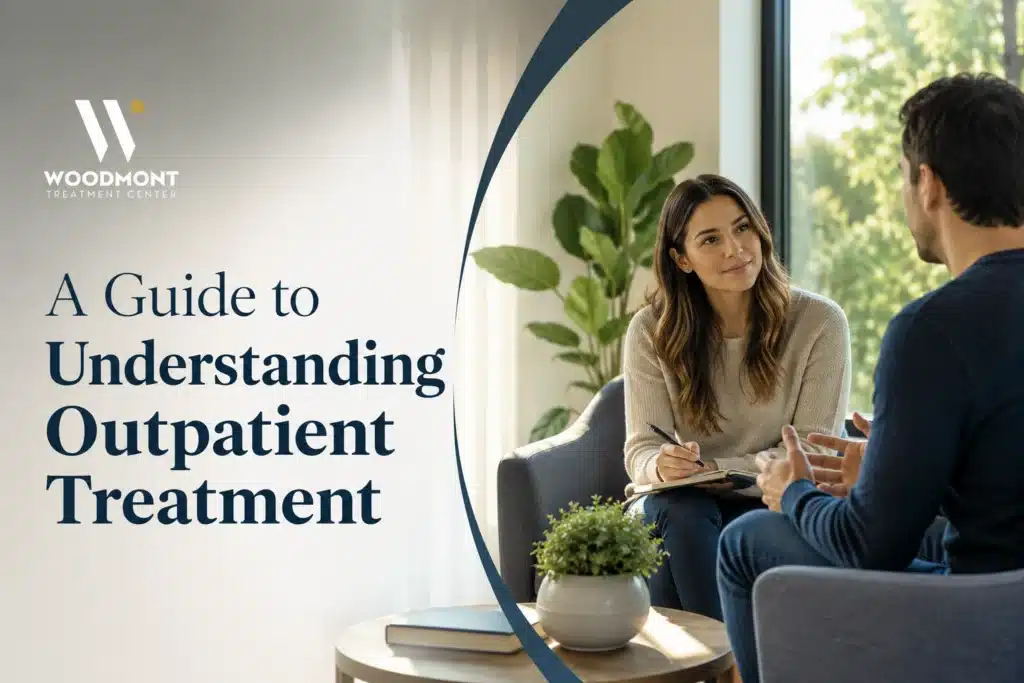
Outpatient treatment means scheduled therapy sessions, individual or group, while a person keeps living at home and handling everyday responsibilities like work or school.
The question what is outpatient treatment comes up constantly because people default to assuming “treatment” always means moving into a facility. It doesn’t. Outpatient care spans everything from intensive programs running several hours a day, several days a week, down to a standard weekly session.
Outpatient care tends to make sense when:
- Someone has already been through detox, and possibly residential care, and is stepping down to something less intensive.
- The addiction is lower severity, without the medical complexity that calls for round-the-clock supervision.
- Home life is stable enough that daily triggers aren’t going to dominate someone’s chances at staying well.
- Work, school, or family obligations make a live-in program unworkable, and outpatient treatment offers a way to stay engaged without stepping fully away from those responsibilities.
Outpatient treatment isn’t a watered-down version of “real” treatment. For the right person, at the right point in recovery, it’s exactly the amount of structure that’s needed, no more and no less.
What Makes Relapse Prevention Actually Work?
Relapse prevention works best when it’s threaded through every stage of treatment, not delivered as a single talk near the end of a program.
What real relapse prevention generally looks like:
- Naming specific personal triggers. Mapped out individually, not pulled from a generic list that doesn’t reflect the actual person.
- A concrete response plan. Clear steps for the moment a warning sign shows up, not a vague plan to “reach out if things get bad.”
- Ongoing therapy after formal treatment ends. Keeps the skills sharp long after the structure of a program disappears.
- Peer and family support. So recovery isn’t something a person is left managing entirely by themselves.
- Scheduled check-ins. Through alumni programs, continued outpatient therapy, or regular contact with a sponsor.
Relapse doesn’t mean treatment failed. More often it means the relapse prevention plan needs adjusting, not scrapping, which is exactly why ongoing support matters just as much as the initial treatment episode did.
What Does Long Term Recovery Look Like in Practice?
Long term recovery isn’t a finish line. It’s an ongoing process built on continued therapy, real support systems, and a life structured around staying well, not just around staying clean.
A few things that tend to show up in sustained recovery:
- Continued outpatient therapy or counseling, scheduled well past the initial treatment episode.
- Stable routines, work, sleep, and structure that supports recovery instead of quietly working against it.
- Rebuilt relationships, especially with family members affected during active addiction.
- A real support network, whether that’s a 12-step community, an alumni group, or ongoing family therapy.
- A relapse prevention plan that gets revisited, adjusted as life changes over months and years, not left untouched.
Woodmont’s aftercare planning starts the day someone enters treatment, not the week before they leave, because the stretch right after structured care ends is often where long term recovery is won or lost.
If you’re ready to talk through what effective treatment could look like for you or someone you love, contact Woodmont Treatment Center for a confidential assessment. We work with individuals and families throughout Sussex, Morris, and Warren County, along with the broader New Jersey region.
Build a Stronger Path to Long Term Recovery
Long term recovery from opioid addiction takes more than getting through withdrawal. At Woodmont Treatment Center, our experienced clinical team provides medically supervised detox, personalized treatment, therapy, relapse prevention, and ongoing aftercare support designed to help you move forward with confidence. Whether you are seeking help for yourself or someone you love, we are here to help you find the right level of care for lasting recovery.
Start Your Confidential AssessmentFrequently Asked Questions
What’s the real difference between detox and full treatment for opioid addiction?
Detox manages the physical withdrawal safely. Full treatment goes further, addressing the therapy, mental health, and behavioral pieces that decide whether recovery actually holds long-term.
How do I know which opioid addiction treatment option fits me or my loved one?
A clinical assessment settles this, weighing severity of use, medical history, home environment, and any co-occurring mental health conditions. Admissions teams walk through it before treatment starts.
Can outpatient treatment work on its own, or does it need inpatient care first?
Depends on severity. Some people do fine starting directly in outpatient care, especially with lower-severity dependence and a stable home. Others need inpatient or residential treatment first before stepping down.
How long does effective opioid addiction treatment usually take?
Varies a lot. Detox often runs 5 to 10 days, inpatient stays commonly land between 30 and 90 days, and outpatient care can continue for months as part of ongoing recovery.
What happens if someone relapses after finishing treatment?
It doesn’t erase the progress already made. A lot of people return briefly to a lower level of care, revisit their relapse prevention plan, and keep moving forward instead of starting over from zero.
Does insurance cover the full range of opioid addiction treatment options?
Most major insurance plans cover levels of care that are clinically necessary. Woodmont’s admissions team verifies your specific benefits before treatment begins.
How involved should a family be in opioid addiction treatment?
As involved as they can be. Family therapy is built into Woodmont’s programming, since recovery tends to hold better when the people at home actually understand what it requires and how to support it.
What role does medication-assisted treatment play in long term recovery?
For a lot of people with opioid use disorder, medications like buprenorphine cut down cravings and relapse risk significantly when paired with therapy. It’s usually one part of a broader plan, not the whole thing.
How soon after treatment should someone focus on aftercare?
Right away, ideally before treatment even ends. Aftercare planning that starts during active treatment produces far stronger outcomes than planning that starts the week of discharge.
How do I start the process of finding effective treatment?
Reach out for a confidential assessment. Woodmont’s admissions team looks at your specific situation, verifies insurance, and helps figure out the right starting point in the continuum of care.