




Finding the Right Bergen County Rehab Center: What You Need to Know
If you’re looking for a bergen county rehab center, here’s a quick overview of what’s available and how to choose the right fit for your unique journey toward wellness. Woodmont Treatment Center provides a premier, sanctuary-like recovery destination for residents across Bergen, Sussex, and Warren Counties.
Top things to know about Bergen County rehab options:
- Levels of care range from medical detox and inpatient withdrawal management to residential, PHP, IOP, and outpatient programs.
- Clinical excellence is defined by the use of evidence-based modalities like CBT, DBT, and trauma-informed care, ensuring that the root causes of addiction are addressed.
- Insurance accepted at most premier facilities includes Aetna, Cigna, BlueCross BlueShield, Medicare, Medicaid, and NJ FamilyCare, making high-quality care accessible.
- 24/7 access to support and information is available through the SAMHSA National Helpline for free, confidential assessments and treatment referrals.
- Specialized programs exist for co-occurring mental health disorders, teens, veterans, and LGBTQ+ individuals, recognizing that every recovery path is personal.
Bergen County is New Jersey’s most populous county. It borders New York City. And like many thriving communities, it is not immune to the devastating reach of addiction. The proximity to major urban centers brings both opportunity and significant challenges regarding substance access and the pressures of modern life. As we navigate the landscape of recovery in April 2026, we see a community that is resilient but still in need of specialized, compassionate support.
The numbers tell a painful story. In 2023, Bergen County recorded 130 overdose deaths — a heartbreaking figure, though it reflects progress from the 220 deaths recorded just two years earlier in 2021. Behind every statistic is a real person. A parent, a sibling, a neighbor. These are lives cut short, and families left to navigate the complex landscape of grief and recovery. This progress is encouraging, but it underscores the ongoing need for high-quality, accessible treatment options.
If you or someone you love is struggling with opioid dependence, alcohol addiction, or a co-occurring mental health condition, the decision to seek help is the most important one you can make. But choosing the right treatment center — one that fits your clinical needs, your lifestyle, and your long-term recovery goals — can feel overwhelming. It is a choice that requires both heart and logic, balancing the need for clinical rigor with the desire for a supportive, healing environment.
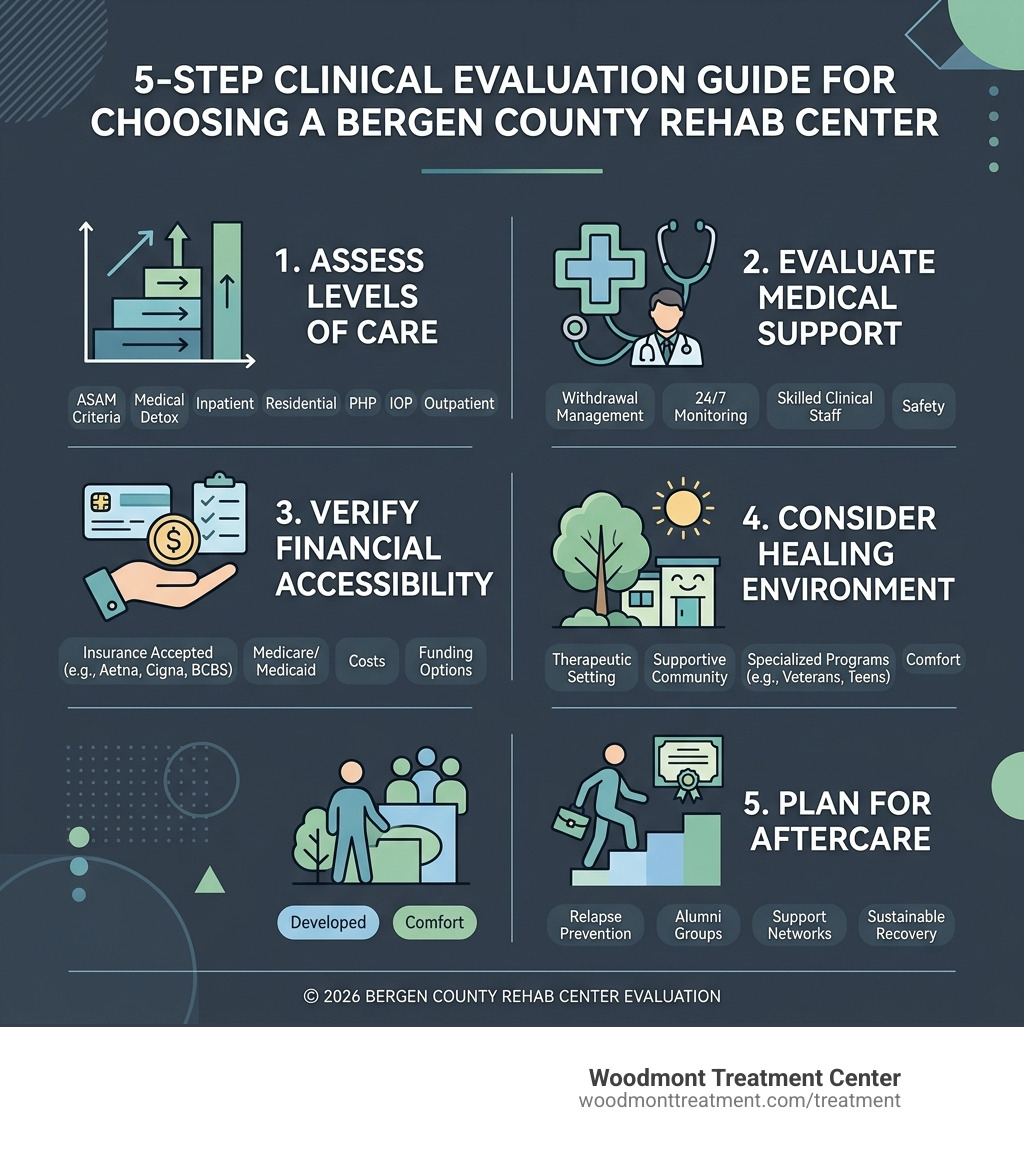
Not every rehab is the same. The difference between a program that changes your life and one that doesn’t often comes down to five key factors: the level of clinical care, the medical support provided, the financial accessibility, the healing environment, and the quality of aftercare. A truly therapeutic environment should feel like a sanctuary, not an institutional facility, providing the peace and security necessary for deep internal work.
This guide walks you through each one — so you can make a confident, informed decision for yourself or your loved one.
Way 1: Assessing Clinical Levels of Care and Specialized Modalities
When you begin your search for a bergen county rehab center, the first thing we must look at is the clinical “fit.” Recovery isn’t a one-size-fits-all t-shirt; it’s more like a custom-tailored suit. To ensure the best outcome, professional facilities use the ASAM (American Society of Addiction Medicine) criteria. These guidelines help us determine exactly where you should start—whether that is a high-intensity residential stay or a flexible outpatient schedule. This assessment considers your physical health, your psychological readiness, and your social support system to ensure you are placed in the environment most conducive to your success.
Understanding the Spectrum of Care
In Bergen County and the surrounding areas like Sussex County, treatment is typically divided into several tiers, each designed to meet specific clinical needs:
- Medical Detox and Withdrawal Management: This is the critical first step for those physically dependent on alcohol, opiates, or benzodiazepines. It involves 24/7 monitoring by medical professionals to ensure toxins leave your system safely, minimizing discomfort and preventing dangerous complications. This phase is about physical safety and stabilization.
- Short-Term Residential Treatment: Often lasting around 21 days, these programs provide intensive stabilization. You live at the facility, away from the triggers of daily life, focusing entirely on your health in a supportive, structured environment. This allows for a complete immersion in the recovery process.
- Partial Hospitalization (PHP) and Intensive Outpatient (IOP): These levels of care allow for deep therapeutic work while you begin to reintegrate into the real world. They offer a bridge between full-time care and independent living, providing several hours of therapy per day while allowing you to return home or to a sober living environment in the evening.
The Power of Evidence-Based Therapy
A premier bergen county rehab center shouldn’t just offer a bed; it should offer a breakthrough. We believe in utilizing the gold standards of psychological care. This includes Cognitive Behavioral Therapy (CBT) to rewire negative thought patterns, Dialectical Behavior Therapy (DBT) for emotional regulation and distress tolerance, and EMDR (Eye Movement Desensitization and Reprocessing) to address the trauma that often sits at the root of substance use. These modalities are not just treatments; they are the building blocks of a new way of living, providing you with the skills to navigate life’s challenges without the need for substances.

By choosing a facility that prioritizes these modalities, you aren’t just “quitting” a substance; you are gaining the mental tools to stay free for a lifetime. Explore our comprehensive treatment programs to see how we structure these levels of care for maximum impact.
Way 2: Integration of Medication-Assisted Treatment (MAT) and Medical Oversight
One of the biggest hurdles in early recovery is the physical “noise” of addiction—the cravings and withdrawal symptoms that can drown out even the strongest will to change. As we look at the landscape of recovery in April 2026, the science is clear: Medication-Assisted Treatment (MAT) is a literal lifesaver.
The Science of Cravings Management
MAT involves the use of FDA-approved medications, such as Vivitrol, Suboxone, and buprenorphine, to stabilize brain chemistry. These aren’t “replacements” for an addiction; they are medical tools that block the euphoric effects of opioids or alcohol and significantly reduce the physical urge to use.
Transitioning from Stabilization to Healing
At Woodmont Treatment Center, we prioritize a transition from physical stabilization to psychological healing. We find that a non-hospital, boutique clinical setting actually promotes better long-term outcomes than a cold, institutional environment. Why? Because you feel like a person, not a patient number.
Personalized medical monitoring in a boutique environment means our nursing staff and physicians know your name, your history, and your specific physical needs. This high-touch medical oversight ensures that as your body heals, your mind is clear enough to engage in the heavy lifting of therapy. Learn more about our clinical approach to MAT and how we integrate it into a holistic recovery plan.
Way 3: Navigating Insurance, PPO Coverage, and Financial Accessibility
We know that one of the first questions on your mind is: “How are we going to pay for this?” The financial aspect of choosing a bergen county rehab center can be daunting, but it shouldn’t be a barrier to saving a life.

Maximizing Your Benefits
Most private treatment centers in the North Jersey area are designed to work seamlessly with PPO (Preferred Provider Organization) and POS (Point of Service) insurance plans. If you have a policy through major providers like Aetna, Cigna, BlueCross BlueShield, or UnitedHealthcare, a significant portion—if not all—of your treatment costs may be covered.
The Value of a Financial Advocate
When you call a facility like ours, you shouldn’t just be talking to an “intake clerk.” You should be speaking with a transparent financial advocate. We take the burden of “insurance gymnastics” off your shoulders by:
- Verifying your coverage immediately.
- Explaining out-of-network benefits for private residential care.
- Providing a clear breakdown of any out-of-pocket costs before you ever step through the door.
In Bergen County, while some facilities accept Medicaid or offer sliding scale fees based on income, private residential centers often provide a higher staff-to-patient ratio and more personalized amenities. Verify your insurance coverage today to see what options are available for your family.
Way 4: Evaluating the Healing Environment and Holistic Wellness

Close your eyes and imagine a rehab center. It should be a sanctuary for growth. We believe in moving away from institutional settings and toward a peaceful environment designed for transformation. A modern, luxurious facility lounge designed for tranquility isn’t just about “fancy furniture”—it’s about creating an atmosphere where your nervous system can finally move out of “fight or flight” mode and into a state of healing.
Treating the Whole Person
A truly effective bergen county rehab center looks at you as a whole human being—biological, psychological, social, and spiritual. This is where holistic wellness comes in:
- Nutritional Support: Feeding your body the nutrients it needs to repair the damage of substance use.
- Mindfulness and Meditation: Teaching you how to sit with your thoughts without needing to escape them.
- Yoga and Fitness: Reconnecting with your physical strength and mobility.
Whether it’s a family-owned facility that prioritizes personalized care or a center that offers specialized tracks for executives or veterans, the goal is the same: creating a personalized care plan that treats the whole person, not just the symptoms. View our luxury facility and amenities to see how environment impacts recovery.
Way 5: Prioritizing Long-Term Success and Comprehensive Aftercare
The real test of a bergen county rehab center isn’t how you feel on day 20; it’s how you feel on day 200. This is why we emphasize the “New Life” aftercare philosophy. Recovery is a journey, not a destination, and the bridge from the facility back to Bergen County needs to be strong.
Building a Foundation for the Future
A comprehensive program doesn’t just say “good luck” and wave goodbye. It builds a foundation through:
- Robust Alumni Networks: Connecting you with others who have walked the path before you.
- Sober Living Transitions: Providing a structured, drug-free environment as you re-enter the community.
- 12-Step and Alternative Support: Whether you prefer the traditional 12-step framework or SMART Recovery, having a peer group is essential.
- Life Skills and Vocational Training: Helping with everything from credit repair and budgeting to job readiness.
Trauma-Informed Prevention
Relapse prevention starts with understanding why you used in the first place. By using trauma-informed care as our foundation, we help you identify the triggers that exist in your daily life in Bergen County and develop a “battle plan” to face them. Learn about our admissions process to see how we start planning for your aftercare from day one.
Frequently Asked Questions about Addiction Treatment for Bergen County Residents
How do I know if I need residential treatment or outpatient care?
This depends on your “clinical acuity.” If you have a long history of relapse, a dangerous home environment, or severe withdrawal symptoms, residential treatment is often the safest choice. It allows you to step away from the local triggers in Bergen County—like that one bar on the corner or a specific group of “friends”—and retreat to a serene Sussex County environment where you can focus entirely on yourself. Outpatient care is generally better for those who have already completed a higher level of care or have a very strong, supportive, and drug-free home life.
What makes a “boutique” rehab different from a traditional facility?
Think of it as the difference between a massive cruise ship and a private yacht. A boutique rehab like Woodmont Treatment Center offers high staff-to-patient ratios, meaning you get more one-on-one time with therapists. You won’t get lost in the crowd. These facilities also prioritize luxurious accommodations and a warm, therapeutic tone, avoiding the cold, institutional feel of traditional large-scale or county-run programs.
What is the difference between PHP and IOP at Woodmont?
- Partial Hospitalization Program (PHP): This is our most intensive outpatient level. It typically runs 5 days a week for several hours a day. You get the structure of a full-time program but usually return home or to a sober living house in the evenings.
- Intensive Outpatient Program (IOP): This offers more flexibility, usually meeting 3 days a week for 3 hours per session. It’s an excellent “step-down” for those starting to go back to work or school but who still need professional support to maintain their sobriety.
How does Woodmont involve the family in the recovery process?
Addiction is a family disease, which means the whole family needs to heal. We offer family therapy sessions and educational workshops to help your loved ones understand the mechanics of addiction. By healing the family unit, we create a much more stable environment for you to return to, which significantly increases the chances of long-term success.
Conclusion
When searching for a bergen county rehab center, you are looking for more than just a facility—you are looking for a new beginning. While Bergen County offers many resources, Woodmont Treatment Center serves as the premier recovery destination for residents of Bergen, Sussex, and Warren Counties. By choosing a facility in the serene landscapes of Sussex County, you give yourself the “breathing room” necessary for true, lasting change.
You move away from the noise of the city and into a space of reflection, luxury, and profound healing. This distance can be a powerful catalyst for transformation, allowing you to disconnect from old patterns and reconnect with your true self in a setting that feels like a sanctuary rather than an institutional setting.
Our commitment to holistic healing, evidence-based therapy, and personalized medical oversight ensures that your path to wellness is as unique as you are. As we look toward the remainder of April 2026, hope is not just a feeling—it’s a plan. We believe that every individual has the capacity for change when provided with the right environment and clinical support. And we are here to help you build that foundation for a life of lasting sobriety.
Start your journey to wellness today. Your new life is waiting.