




When 30 Days Isn’t Enough: What Long Term Residential Rehab Really Offers
Long term residential rehab is a structured, live-in addiction treatment program lasting 90 days or more — often 6 months, 1 year, or even 2 years — where you receive round-the-clock clinical support, evidence-based therapy, and personalized care under one roof.
Here’s a quick snapshot of what it involves:
| Feature | Long Term Residential Rehab |
|---|---|
| Duration | 90 days to 2+ years |
| Setting | Live-in, non-hospital facility |
| Support | 24/7 clinical and peer support |
| Best for | Severe addiction, relapse history, co-occurring disorders |
| Core goal | Lasting recovery, not just short-term sobriety |
If you or someone you love has been through a 30-day program — or several — and found yourself back at square one, you’re not alone. And it’s not a personal failure.
The reality is that most short-term programs are shaped by insurance billing cycles, not clinical research. According to the National Institute on Drug Abuse (NIDA), treatment programs lasting fewer than 90 days show significantly worse outcomes for moderate-to-severe addiction.
The brain needs time to heal. Relationships need time to rebuild. And real behavioral change doesn’t happen in a month.
That’s why extended residential care exists — and why the research behind it is so compelling.
At Woodmont Treatment Center, located in the heart of Sussex and Warren County, New Jersey, we understand that recovery is not a sprint. It’s a deeply personal journey that requires the right environment, the right team, and enough time to do the work that actually lasts.
Understanding the Efficacy of Long Term Residential Rehab

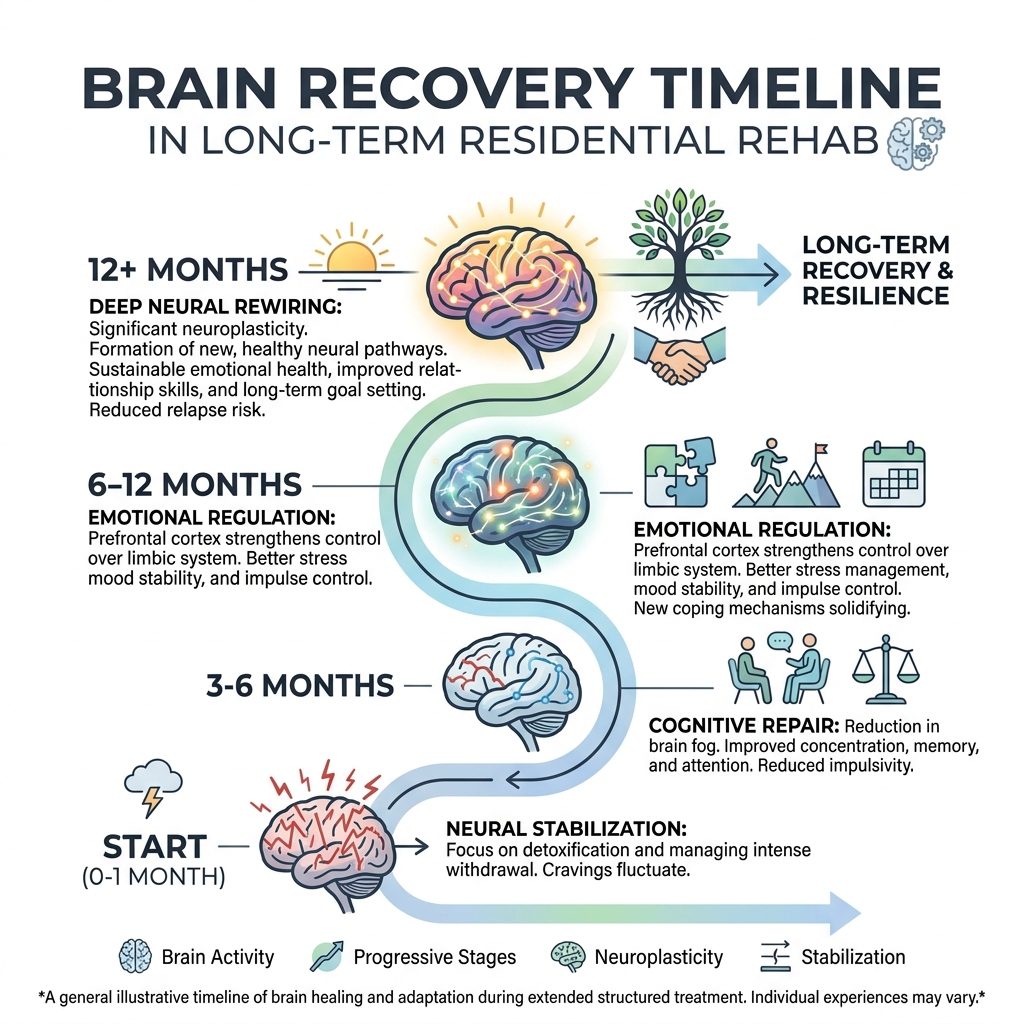
When we talk about addiction, we have to talk about the brain. Substance use disorder isn’t just a “bad habit”; it’s a chronic disease that physically alters the neural pathways responsible for decision-making, stress response, and pleasure. Expecting those pathways to reset in 28 days is a bit like expecting a broken leg to heal after a weekend of rest. It’s a good start, but the real work of walking again takes much longer.
The 90-day minimum isn’t just a number we pulled out of a hat. It is the evidence-based minimum for people with serious addiction. Research consistently shows that staying in treatment for at least three months significantly improves the chances of sustained sobriety.
In a Long Term Residential Rehab setting, we utilize the “therapeutic community” model. This means the environment itself becomes a tool for healing. By living, eating, and working alongside peers who are on the same journey, residents learn accountability, social responsibility, and how to navigate life’s frustrations without reaching for a substance. We aren’t just treating the addiction; we are reconstructing a lifestyle.
Who is Best Suited for Long Term Residential Rehab?
While any level of care is better than no care, certain individuals find that extended residency is the only way to break the cycle of “revolving door” rehab. We often recommend this path for:
- Those with a chronic relapse history: If you’ve tried 30-day programs before and relapsed shortly after, it’s a clear indicator that your brain and body need more time to stabilize.
- Individuals with co-occurring disorders: Treating a dual diagnosis (like addiction plus depression, PTSD, or anxiety) is a complex dance. It takes time to distinguish between psychiatric symptoms and substance-induced behaviors.
- Low recovery capital: If your home environment is unstable, or if you lack a supportive social circle in Sussex or Warren County, staying in a safe, therapeutic environment provides the “capital” you need to build a foundation.
- Severe or long-standing substance use: The longer the addiction has lasted, the more time the nervous system needs to return to a baseline of health.
If you recognize yourself or a loved one in these descriptions, we invite you to explore our comprehensive treatment programs to see how a longer stay can change the trajectory of your life.
Essential Components of Long Term Residential Rehab
A quality program isn’t just a place to sleep; it’s a 24/7 clinical ecosystem. At Woodmont Treatment Center, we believe the “luxury” of our facility isn’t just about comfort—it’s about creating a space where the nervous system can finally feel safe enough to begin deep therapeutic work.
The essential components include:
- 24/7 Clinical Support: Having access to medical and therapeutic professionals at any hour of the day or night ensures safety during the most vulnerable moments of early recovery.
- Personalized Care Plans: No two addictions are the same. We tailor every plan to the individual’s history, trauma, and goals.
- Peer Accountability: In a long-term setting, your peers become your family. You learn to give and receive feedback, which is vital for emotional maturity.
- Vocational Training and Life Skills: Many people lose years of their lives to addiction and may need help with “adulting”—from financial literacy to job readiness.
- Family Restoration: We don’t just treat the resident; we work to heal the family unit, helping to repair the trust that was broken during active use.
To learn more about how we bring these pieces together, you can find more info about our admissions process on our website.
The Clinical Superiority of Extended Care Durations
The numbers don’t lie. When we look at the Long-term study on therapeutic communities (DATOS), the outcomes for those who stay in treatment for six months or more are nothing short of transformative.
According to the NIDA-sponsored DATOS research, individuals who completed at least six months of residential treatment saw:
- Cocaine use decrease by 83%
- Problem alcohol use decrease by 90%
- Suicidal thoughts and attempts decline by 96%
- Full-time employment increase by 46%
These aren’t just statistics; these are lives restored. The “clinical superiority” of Long Term Residential Rehab comes down to nervous system regulation. The first few weeks of treatment are often spent just getting the body through detox and the initial fog of withdrawal. Deep therapeutic work—the kind that addresses the “why” behind the use—usually doesn’t even begin until week four or five. In a 30-day program, you’re leaving just as the real healing starts.
In 6-month, 1-year, or 2-year residencies, residents have the time to practice new coping skills in real-world-adjacent scenarios while still having a safety net. This “rehearsal” period is what makes the difference between a temporary pause in use and a permanent change in identity.
Criteria for the 5 Best Long Term Residential Rehabilitations
If you are searching for the best Long Term Residential Rehab in New Jersey—specifically in Sussex, Warren, or Bergen County—it’s important to know what makes a facility “the best.” It isn’t just about the thread count of the sheets; it’s about the clinical integrity of the program.
When evaluating the top five characteristics of a premier facility, look for these gold standards:
- High Accreditation Standards: The best facilities are accredited by the Joint Commission or CARF (Commission on Accreditation of Rehabilitation Facilities). These certifications ensure the center meets rigorous safety and quality benchmarks.
- Multidisciplinary Teams: You shouldn’t just see a counselor once a week. A top-tier center has a team that includes psychiatrists, licensed clinical social workers, ASAM-certified medical personnel, and nutritionists.
- Low Staff-to-Client Ratios: Personalized care is impossible if the staff is overwhelmed. Smaller group sizes allow for more intensive individual attention.
- Non-Hospital, Therapeutic Environment: Research shows that “clinical-feeling” environments can actually trigger stress in those with trauma. Woodmont Treatment Center is the premier facility in Sussex and Warren County because we offer a luxury, home-like environment where residents feel respected and comfortable.
- Evidence-Based Modalities with Holistic Integration: The best programs bridge the gap between hard science (like CBT and DBT) and holistic wellness (like yoga and equine therapy).
Before committing, we always recommend that you verify your insurance coverage today to understand what options are available to you under your specific plan.
Evidence-Based Therapies and Holistic Services
A “one-size-fits-all” approach is the enemy of recovery. The best long-term programs utilize a “buffet” of evidence-based therapies, including:
- Cognitive Behavioral Therapy (CBT): Helping you identify and change the thought patterns that lead to substance use.
- Dialectical Behavior Therapy (DBT): Focuses on emotional regulation and distress tolerance—essential for those with co-occurring mental health issues.
- Medication-Assisted Treatment (MAT): When appropriate, using FDA-approved medications to manage cravings and brain chemistry.
- 12-Step Principles: We often incorporate Scientific research on 12-step principles to help residents build a peer-led support network that will exist long after they leave our doors.
We also believe in healing the whole person. This is why we integrate holistic services like equine therapy, sound healing, and nutritional counseling. Addiction often leaves the body depleted; we aim to rebuild it from the inside out.
Specialized Tracks for Complex Needs
Every person walks through our doors with a unique story. To provide the best care, we offer specialized tracks, such as:
- Gender-Specific Care: Men and women often process trauma and social pressure differently. Having space to discuss these issues among peers of the same gender can lead to deeper breakthroughs.
- Dual Diagnosis Integration: We don’t treat the addiction in one room and the mental health in another. Our ASAM-certified medical personnel ensure that both issues are addressed simultaneously.
- PTSD and Trauma Protocols: For many, addiction is a “solution” to the pain of past trauma. Our trauma-informed framework ensures that we address these wounds with the care and time they require.
Navigating Costs and Insurance for Extended Treatment
One of the biggest hurdles to Long Term Residential Rehab is the concern over cost. However, there is good news: insurance coverage for addiction treatment has improved significantly in recent years.
Under the Affordable Care Act, substance abuse treatment must be covered as an “essential health benefit.” This means that ACA-compliant plans cannot disqualify you for a pre-existing condition or put a lifetime spending cap on your treatment.
Most private PPO plans offer substantial coverage for residential care. At Woodmont Treatment Center, we work with a wide range of providers to ensure our residents can access the care they need. We understand that navigating deductibles, out-of-pocket maximums, and mental health parity laws can be overwhelming. That’s why our admissions team handles the heavy lifting for you.
You can verify your insurance coverage today through our secure online form, and we will provide a clear breakdown of what your plan covers.
The Continuum of Care: From Intake to Aftercare
Recovery doesn’t end when the residential phase is over. In fact, the transition back into the world is often the most critical time. A quality Long Term Residential Rehab program views treatment as a continuum, not a single event.
The journey typically looks like this:
- Medically Monitored Detox: Ensuring you are safe and comfortable as the substances leave your system.
- Primary Residential Phase: The intensive work of therapy, group sessions, and lifestyle reconstruction.
- Step-Down Care: Moving from 24/7 supervision to a partial hospitalization (PHP) or intensive outpatient (IOP) model while still living in a structured environment.
- Sober Living: Transitioning to a recovery-focused home where you have more freedom but still maintain accountability.
- Alumni Support: Staying connected to the community that helped you save your life.
For more details on how we structure these phases, check out more info about our treatment services.
Transitioning After Long Term Residential Rehab
The goal of long-term care is “community reintegration.” We want you to be a flourishing member of society in Newton, Andover, or wherever you call home. To ensure a smooth transition, we focus on several post-treatment milestones:
- Establishing a Local Support Network: Whether it’s 12-step meetings or SMART Recovery groups in Sussex County.
- Securing Stable Housing: Ensuring your home environment is a “safe zone.”
- Ongoing Outpatient Check-ins: Keeping a “pulse” on your recovery with regular therapy sessions.
- Employment or Education: Returning to work or school with a clear mind and a new sense of purpose.
Frequently Asked Questions about Long-Term Rehab
How long is long-term residential rehab?
Typically, anything beyond 90 days is considered long-term. Programs can last 6 months, 1 year, or even up to 2 years, depending on the severity of the addiction and the progress of the individual.
Does insurance cover a 6-month or 1-year stay?
Many insurance plans do cover extended stays, though the level of coverage depends on your specific policy and the “medical necessity” as determined by clinical assessments. We recommend checking with your provider or having our team do an insurance verification for you.
What is the difference between inpatient and residential treatment?
“Inpatient” often refers to a more clinical, hospital-based setting focused on short-term stabilization. “Residential” treatment, like what we offer at Woodmont, takes place in a home-like environment and focuses on long-term behavioral change and lifestyle reconstruction.
Conclusion
Recovery is a therapeutic journey that requires patience, courage, and—most importantly—time. While a 30-day “reset” might seem appealing, the data is clear: Long Term Residential Rehab offers the best chance for a life free from the chains of addiction.
By choosing a facility like Woodmont Treatment Center, you are choosing Sussex County excellence and Warren County resources. You are choosing a team that sees you as a human being with a future, not just a patient with a diagnosis. We are committed to walking this path with you for as long as it takes to reach sustainable, lifelong sobriety.
If you’re ready to take that first, brave step toward a new life, we are here to help. Explore our comprehensive treatment programs today and let’s start this journey together.